Migrating a Moroccan Store from YouCan to Next.js and NestJS
Rebuilding Wadoxe, a bilingual Arabic and French store: redirects, delivery per city, a back office the team runs alone, and where AI helps.
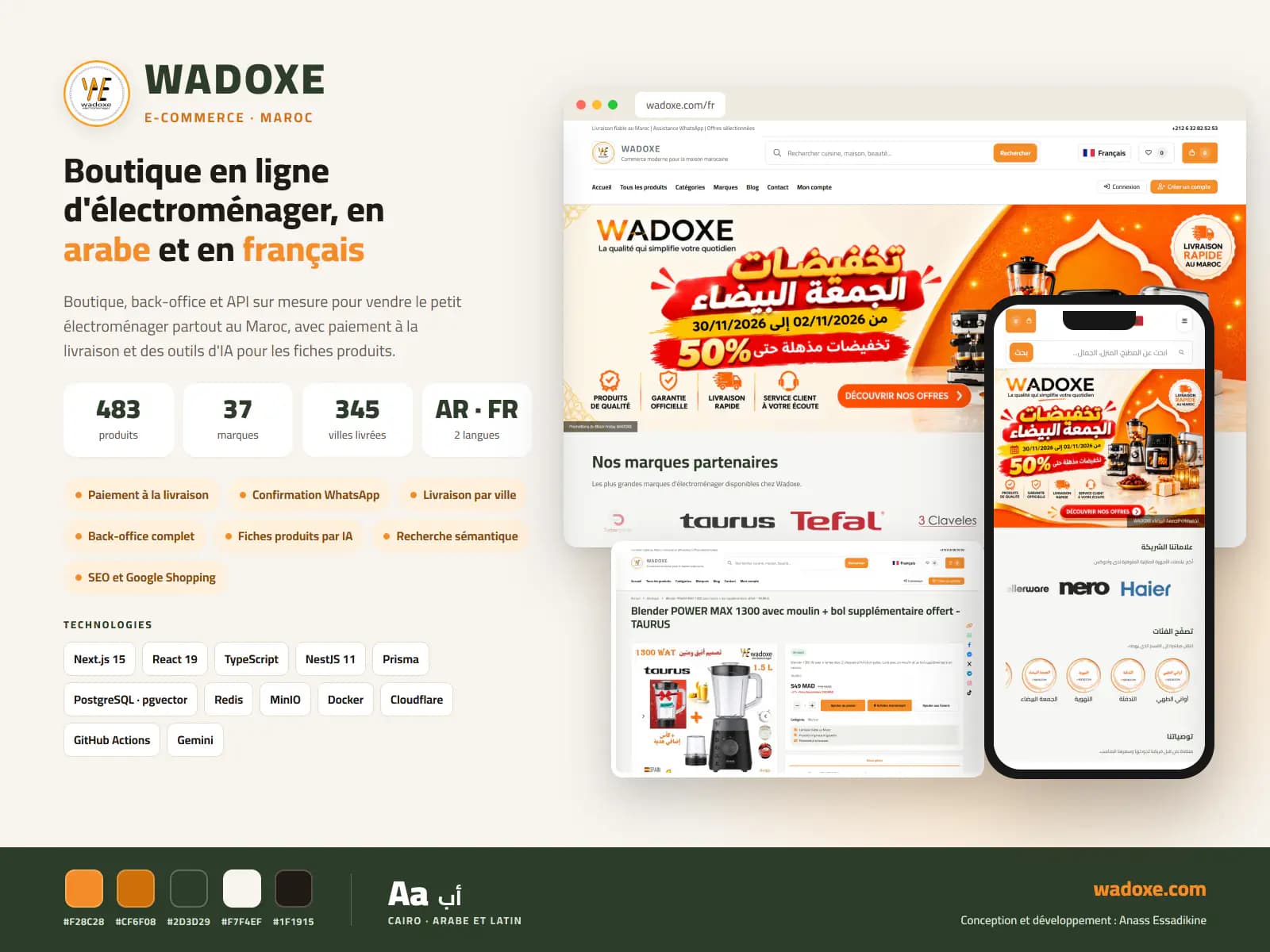
Wadoxe sells small home appliances and cookware across Morocco: air fryers, blenders, stand mixers, vacuum cleaners, heaters. When they came to me, the shop ran on YouCan, a hosted store builder that is popular here. It worked, but the team kept hitting the same wall: anything outside the template (a promotion with its own rules, a product pack, a landing page, real SEO control) needed a workaround or was not possible at all.
So we rebuilt it. Store, back office and API, all custom. This post is about the decisions that mattered, not a feature tour.
The constraints I started from
Four things were non-negotiable:
- Do not lose Google rankings. The old store had pages that people found. Every one of them had to keep working after the switch.
- Arabic and French, both for real. Not a translation plugin. Arabic right to left, with its own URLs and its own SEO.
- Mobile first. Most visitors are on a phone, often on a mid-range Android and mobile data.
- The team runs everything alone. Orders, stock, promotions, content. If they need me to change a banner, I failed.
And the business reality of Moroccan e-commerce: most orders are cash on delivery, delivery costs depend on the city, and orders get confirmed on WhatsApp before they ship.
The stack, and why
- Next.js 15 (React 19) for the store, rendered on the server with caching. Product and category pages are what Google sees first, so they had to arrive as HTML, fast.
- NestJS 11 + Prisma 6 + PostgreSQL 16 for one API shared by the store and the back office. One source of truth for prices, stock and orders.
- pgvector inside the same Postgres for semantic product search. I did not want a second search service to run and pay for.
- Redis for cache and queues, MinIO for images.
- Docker on a VPS behind Caddy and Cloudflare, deployed by GitHub Actions. Daily backups of the database and images, with an off-site copy.
Nothing exotic. The goal was a stack one developer can operate for years.
Migration: the part that decides if the project succeeds
The catalogue moved over in full: 483 products, 37 brands and 25 collections, with their photos and descriptions.
The bigger job was URLs. YouCan has its own URL patterns and the new store has clean, bilingual ones. I built a redirect for every old address to its new page, so links shared on WhatsApp months ago, and pages Google had indexed, land on the right product instead of a 404.
If you do a migration like this, treat the redirect map as a feature with tests, not as a task at the end. It is the difference between keeping your traffic and starting from zero.
Built for how people actually buy in Morocco
- Cash on delivery by default, with coupons and a loyalty program.
- A delivery price for each of 345 cities. Flat shipping would either lose money on far cities or overcharge near ones.
- Guest checkout, because asking for an account before a first order kills conversion.
- WhatsApp order confirmation, and a "call back" status in the back office with a reminder on the day the customer asked to be called.
That last one came from how the team works: a lot of customers say "call me tomorrow". Now that is a status with a date, not a note on paper.
A back office the team can run alone
Some of the things I am happiest with are boring on purpose:
- Bulk status changes on orders.
- Editing the products inside an existing order, with stock and totals recalculated automatically.
- Abandoned carts and unsent checkout forms that can be turned into orders. People often fill the form, then hesitate. Those are warm leads.
- Promotions, coupons, packs, a media library and a rich content editor, so marketing pages do not need a developer.
- Excel exports and sales analytics by traffic source, so they know which channel actually sells.
- Roles and permissions per user, two-factor authentication and a change history.
Where AI actually helps (and where it does not)
I used AI for three narrow jobs, each with a person checking the result:
- Product pages. Gemini drafts descriptions, the Arabic and French versions and the SEO texts. The team edits and publishes.
- Search. Embeddings stored with pgvector let a search like "something to make juice" find blenders even when the word is not in the title.
- Order entry from a WhatsApp screenshot. Customers send orders as screenshots. The back office reads one and pre-fills the order form.
None of these replace the team. They remove the copy and paste.
SEO, in two languages
- Structured data for products, the organization, the website and breadcrumbs.
- Sitemaps and Arabic/French hreflang so each language version is indexed as its own page.
- A Google Merchant Center feed for Google Shopping.
- An llms.txt file, so AI assistants get a clean summary of the store.
- And the redirects from every old URL, which matter more than all of the above.
What I would tell someone starting the same project
- Write the redirect map before you write the new templates.
- Model delivery cost per city from day one. Retrofitting it is painful.
- Put the "messy" real-world flows (call back later, abandoned forms, screenshot orders) in the back office as first-class features. That is where the time goes for the team.
- Keep the stack small enough that you can run it alone at 2 a.m.
The store is live at wadoxe.com. The full case study, with the architecture and the complete feature list, is on my site: Wadoxe case study.
I am Anass Essadikine, a full-stack developer and Data & AI engineer in Casablanca. If you are planning a migration off a hosted store builder, or a bilingual Arabic store, get in touch.
- E-commerce
- Next.js
- NestJS
- Migration
- SEO
- Morocco
Share this article

About the author
Anass Essadikine
Data & AI Engineer and Software Engineer based in Casablanca, Morocco. I build data platforms, Power BI dashboards, RAG assistants and Next.js / Spring Boot applications.
Related projects
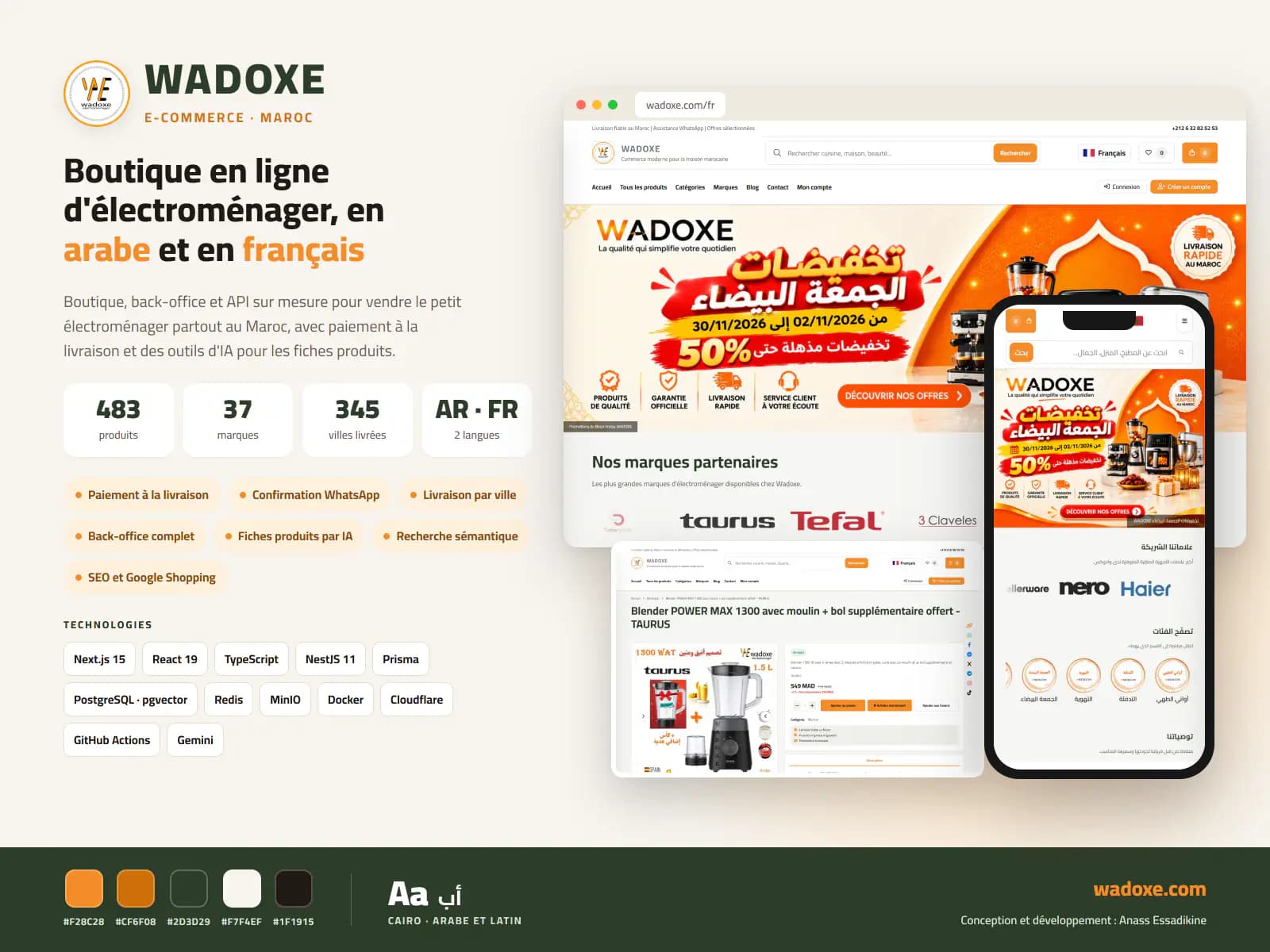
Wadoxe: Online Home Appliance Store in Morocco
A bilingual Arabic and French online store for small home appliances and cookware: 483 products, 37 brands, delivery to 345 cities in Morocco and cash on delivery. Custom store, back office and API, with AI tools for product pages.
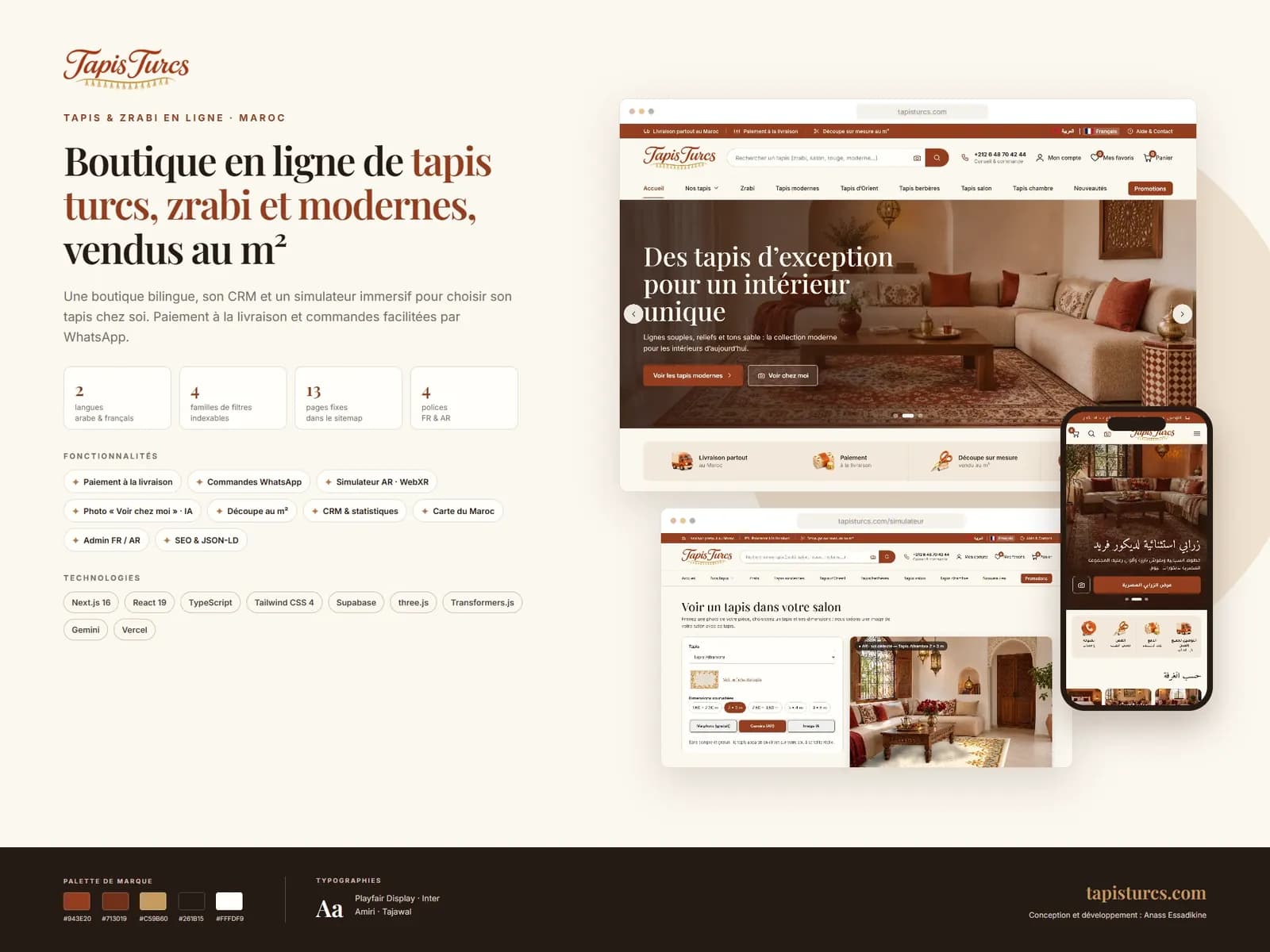
TapisTurcs: Online Rug Store with AR Preview in Morocco
A bilingual Arabic and French online store for Turkish, zrabi and modern rugs sold per square meter, with cash on delivery, an AR and photo room preview, and a back office with a CRM.
Frequently asked questions
Not if every old URL redirects to its new page. On Wadoxe every old address was redirected, so indexed pages and links shared on WhatsApp still land on the right product.
Next.js renders product pages on the server, so they load fast on mobile and are easy for Google to read. NestJS gives one API for the store and the back office, so prices, stock and orders have a single source of truth.
Yes. Wadoxe uses cash on delivery by default and has a delivery price for each of 345 cities, with order confirmation on WhatsApp and a call back status in the back office.