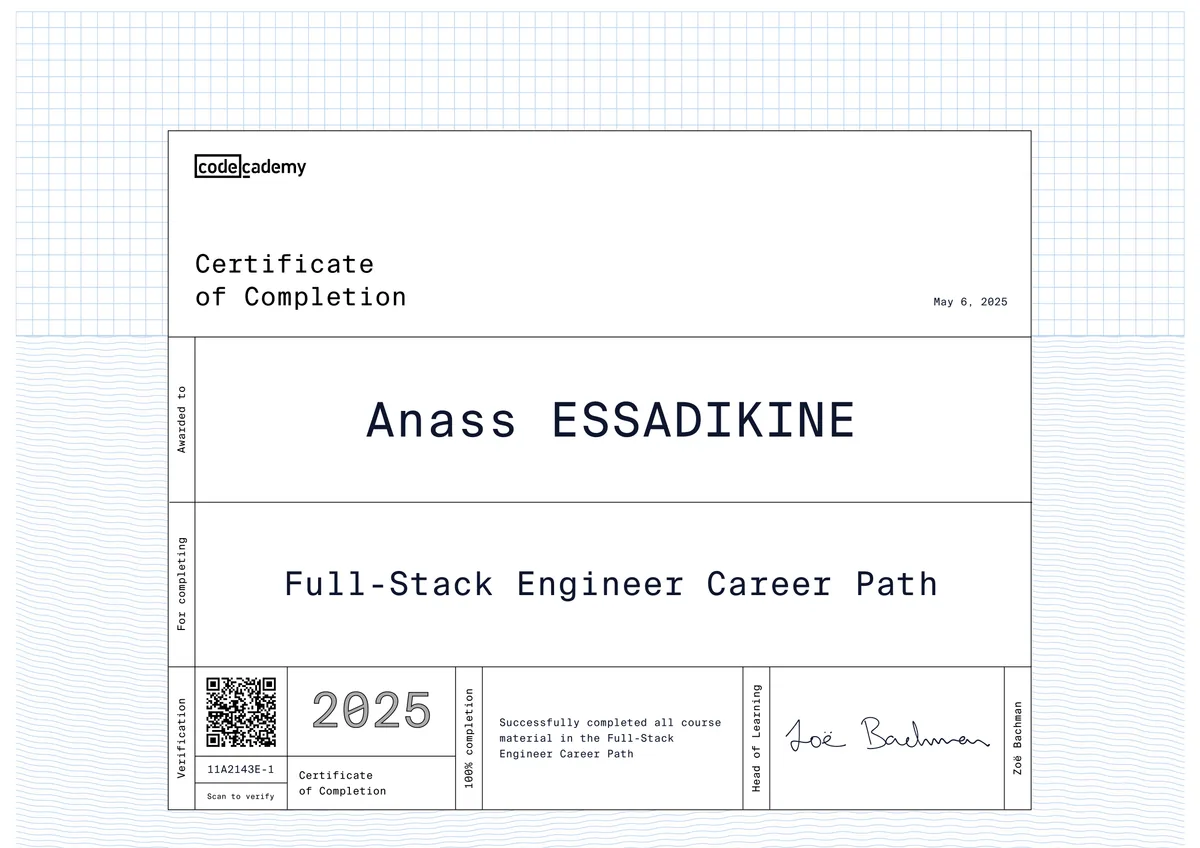
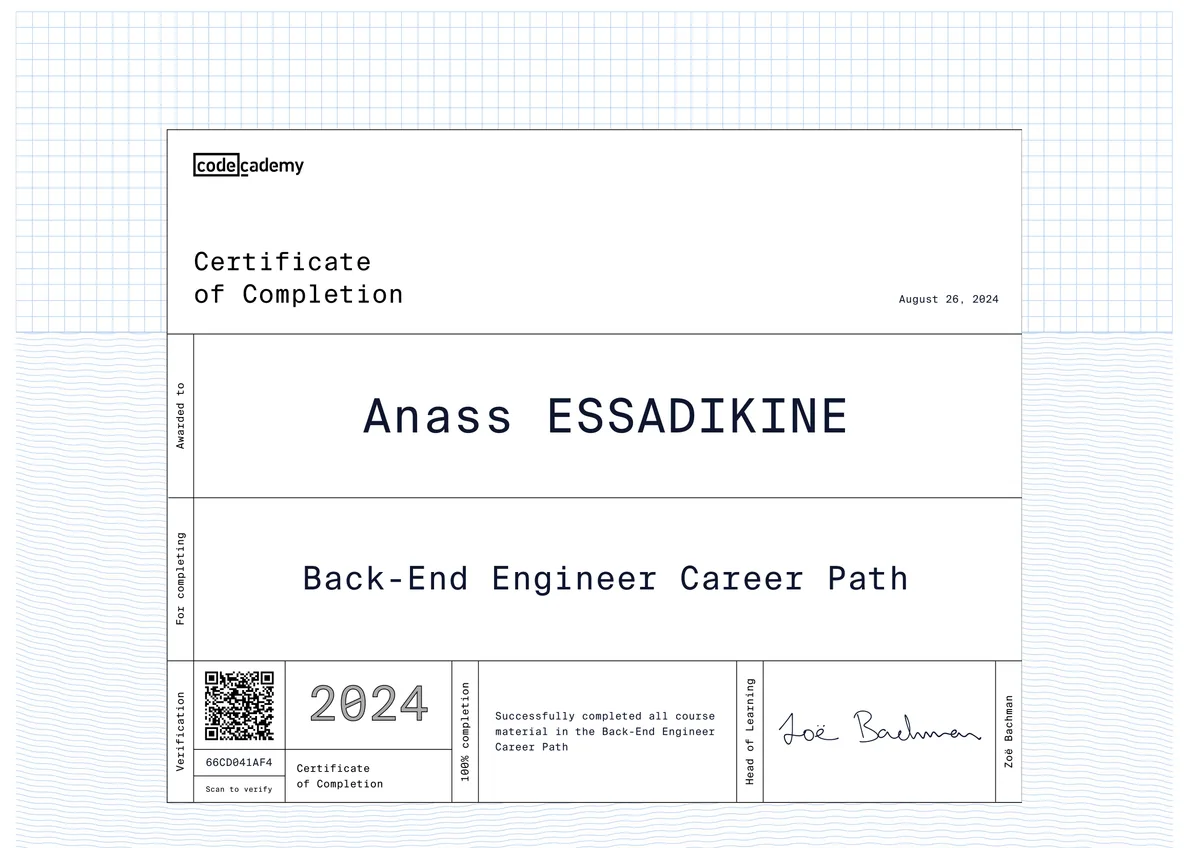
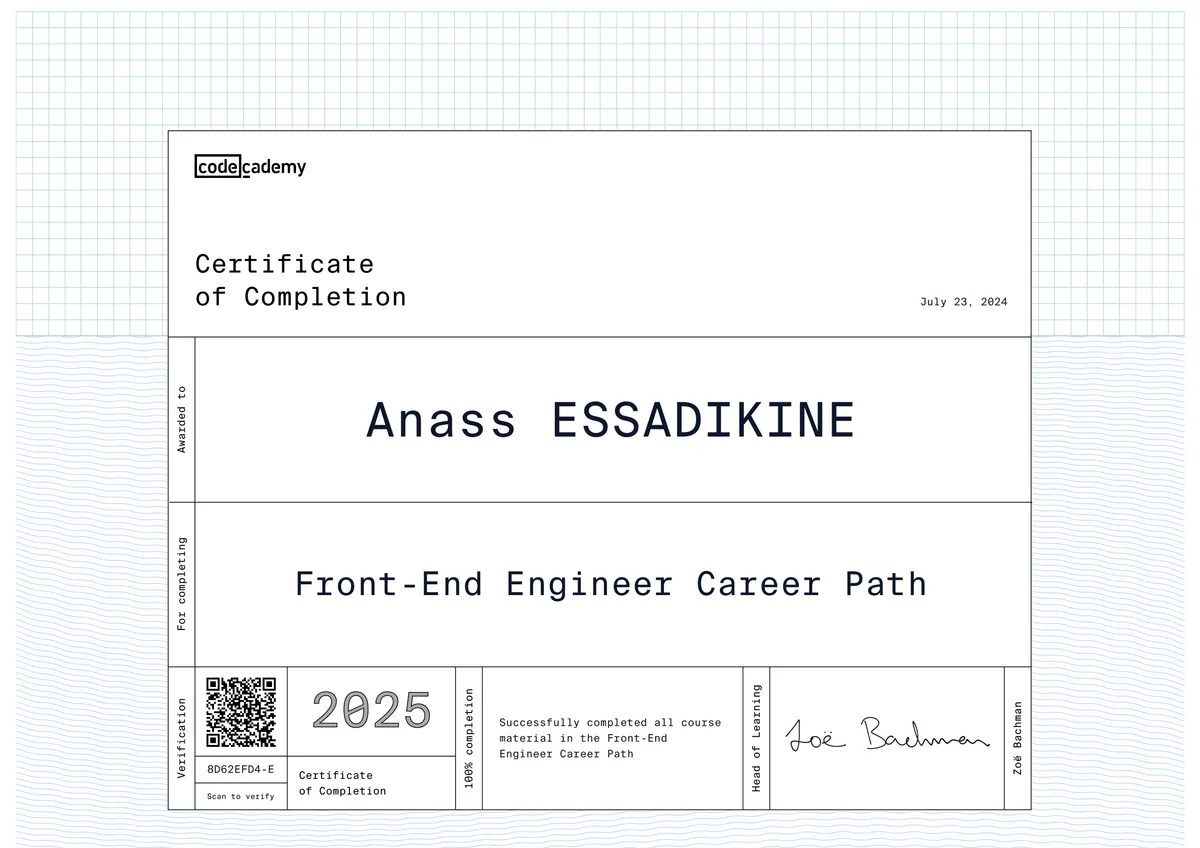
Computer Science Career Path: The CS Fundamentals Behind My Code
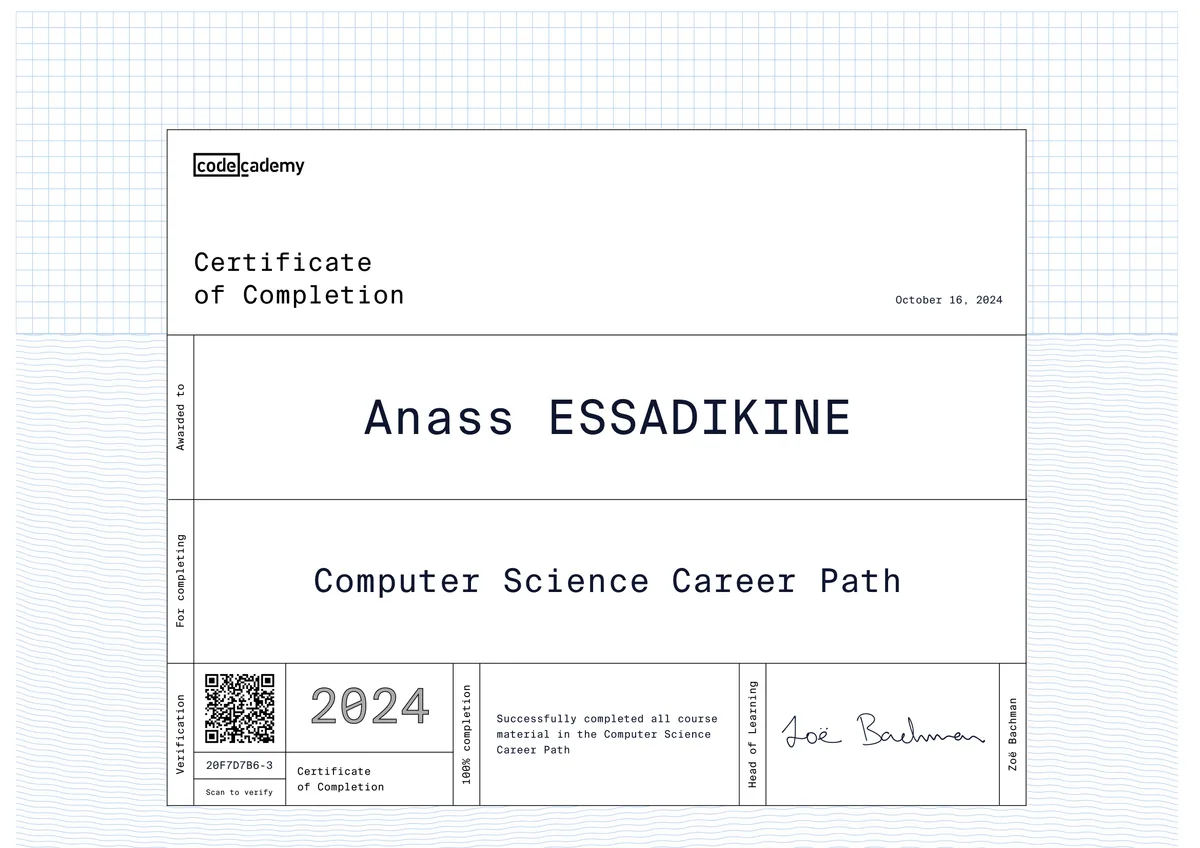
Codecademy's Computer Science Career Path is a project-based curriculum covering the core foundations every software engineer needs before touching a specific framework: Python programming, object-oriented design, data structures, algorithms, complexity analysis, SQL, and Git-based version control. Every concept (hash tables, sorting algorithms, recursion) is implemented from scratch rather than called from a library, which is where the actual understanding happens.
This matters because most self-taught or bootcamp paths jump straight to frameworks and skip exactly what technical interviews and senior engineers probe for: how to pick the right data structure, why one algorithm scales and another doesn't, and how to reason about Big O before code ever hits production. This credential is verifiable proof those fundamentals aren't a gap in my background.
What I learned
Programming Foundations with Python
Variables, control flow, loops, functions, and complex data types (lists, dictionaries), using Python as the language for the entire path.
Object-Oriented Programming
Designing classes, inheritance, and encapsulation in Python to model real-world systems instead of writing purely procedural scripts.
Data Structures
Implementing arrays, hash tables, linked lists, stacks, queues, trees, and graphs from scratch to reason about their memory and access-speed trade-offs.
Algorithms and Recursion
Recursion, sorting algorithms (bubble, merge, quicksort), and searching algorithms (linear and binary), implemented and compared directly.
Analyzing Complexity (Big O Notation)
Evaluating the time and space complexity of code to choose the more efficient of two working solutions, a core technical-interview skill.
Databases and SQL
Querying and manipulating relational data with SQL: SELECT statements, joins, aggregate functions, and table transformations.
Command Line and Git/Version Control
Navigating the file system with Bash and managing code history, branches, and collaboration through Git and GitHub.
Technical Interview Prep and Capstone Project
Whiteboard-style problem solving and mock coding interviews, followed by a capstone project applying the full stack of CS skills learned in the path.
Tools & technologies
- Python
- SQL
- Git
- GitHub
- Bash / Command Line
Applied in my projects
These fundamentals show up directly in my work: the Python, Pandas, and Scikit-learn pipeline in the Sales Prediction App with Django & ML relies on the same data-structure and algorithmic thinking this path builds; the Cloud Deployment with Automated CI/CD project runs on Git/GitHub workflows and Bash scripting straight out of the command-line module; and the relational schema and backend logic behind University Housing Management (FSBM): built with Spring Boot and MySQL, draw on the OOP and SQL units of this certification.
Why this matters for employers
The Computer Science Career Path isn't another framework tutorial: it certifies the fundamentals that separate a tutorial-following developer from a hireable engineer: choosing the right data structure, reasoning about a solution's time and space complexity, writing clean object-oriented Python, querying a relational database correctly, and working inside a Git-based team workflow. Those are exactly what technical screens and take-home assessments test, and they transfer across every stack I use: Java/Spring Boot on FSBM Housing Management, Python/Scikit-learn on the sales-forecasting app, Bash/Git in CI/CD pipelines. For an employer, that means less onboarding risk: I can debug performance issues, design schemas, and read someone else's code, not just glue together tutorials.
Verified certificate
Download the official certificate for this achievement.
- Computer Science Career Path Codecademy
- data structures and algorithms certification
- Python developer Casablanca Morocco
- Big O notation complexity analysis
- SQL certification for developers
- Git and GitHub version control
- technical interview preparation course
- software engineer fundamentals certification
This certification is part of my Full-Stack Developer profile. All my credentials are on the certifications page.
Related projects
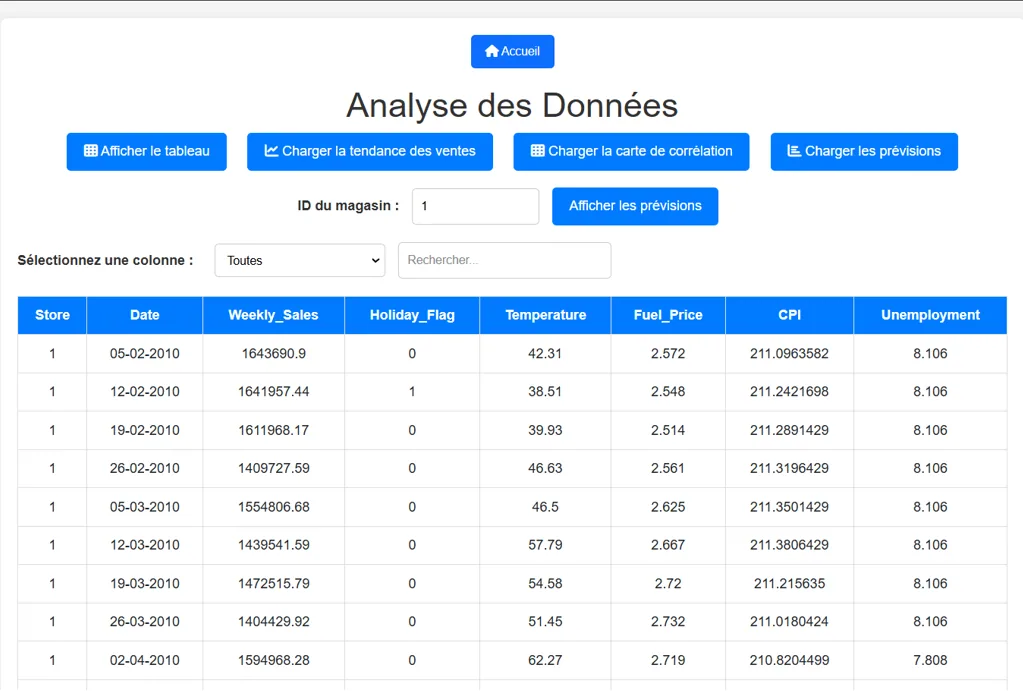
Sales Prediction App with Django & ML
A predictive analytics web app that forecasts sales and shows the results through interactive charts.
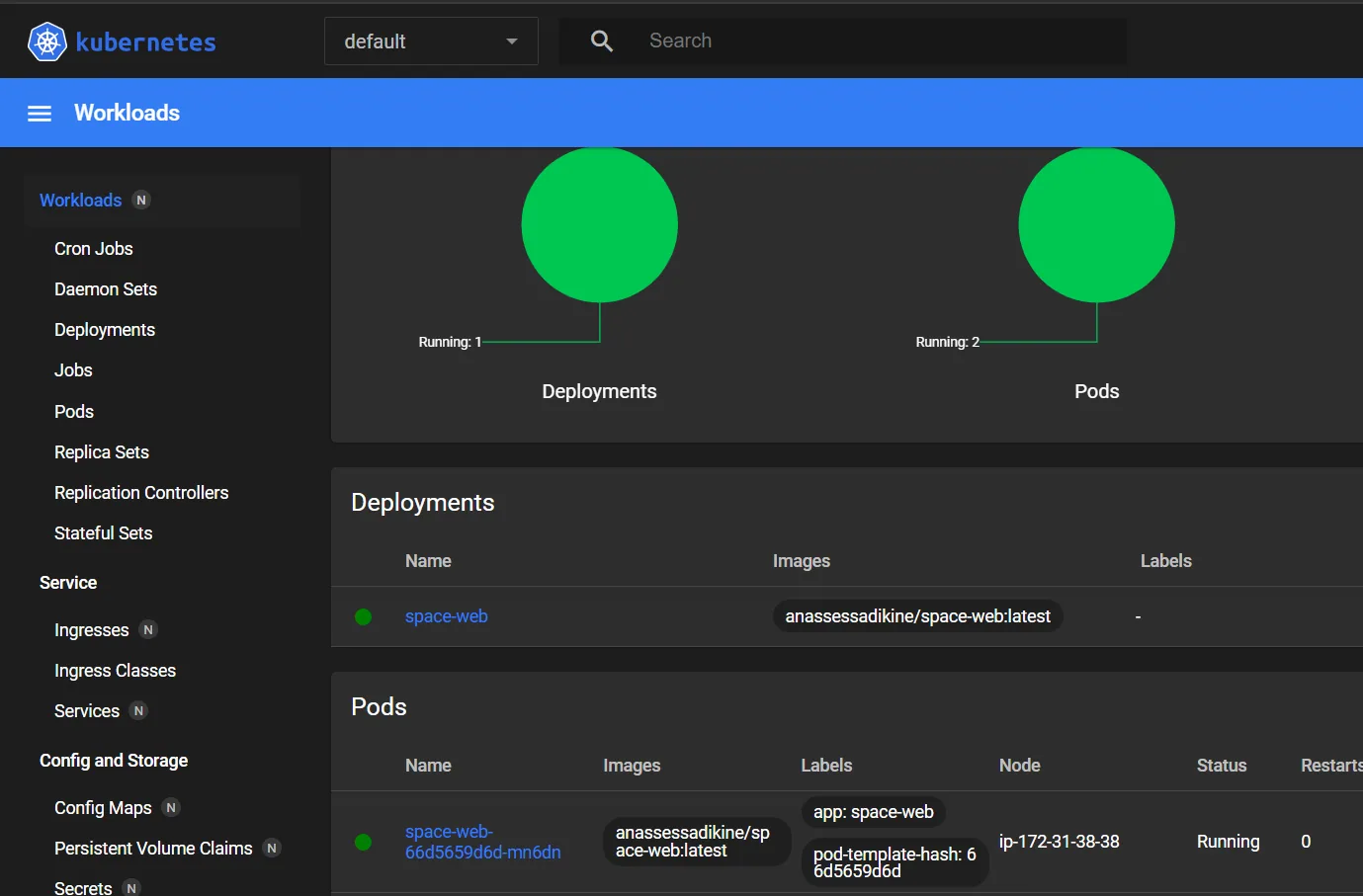
Cloud Deployment with Automated CI/CD
An end-to-end pipeline that builds, containerises and deploys a React app to Kubernetes on AWS on every push.
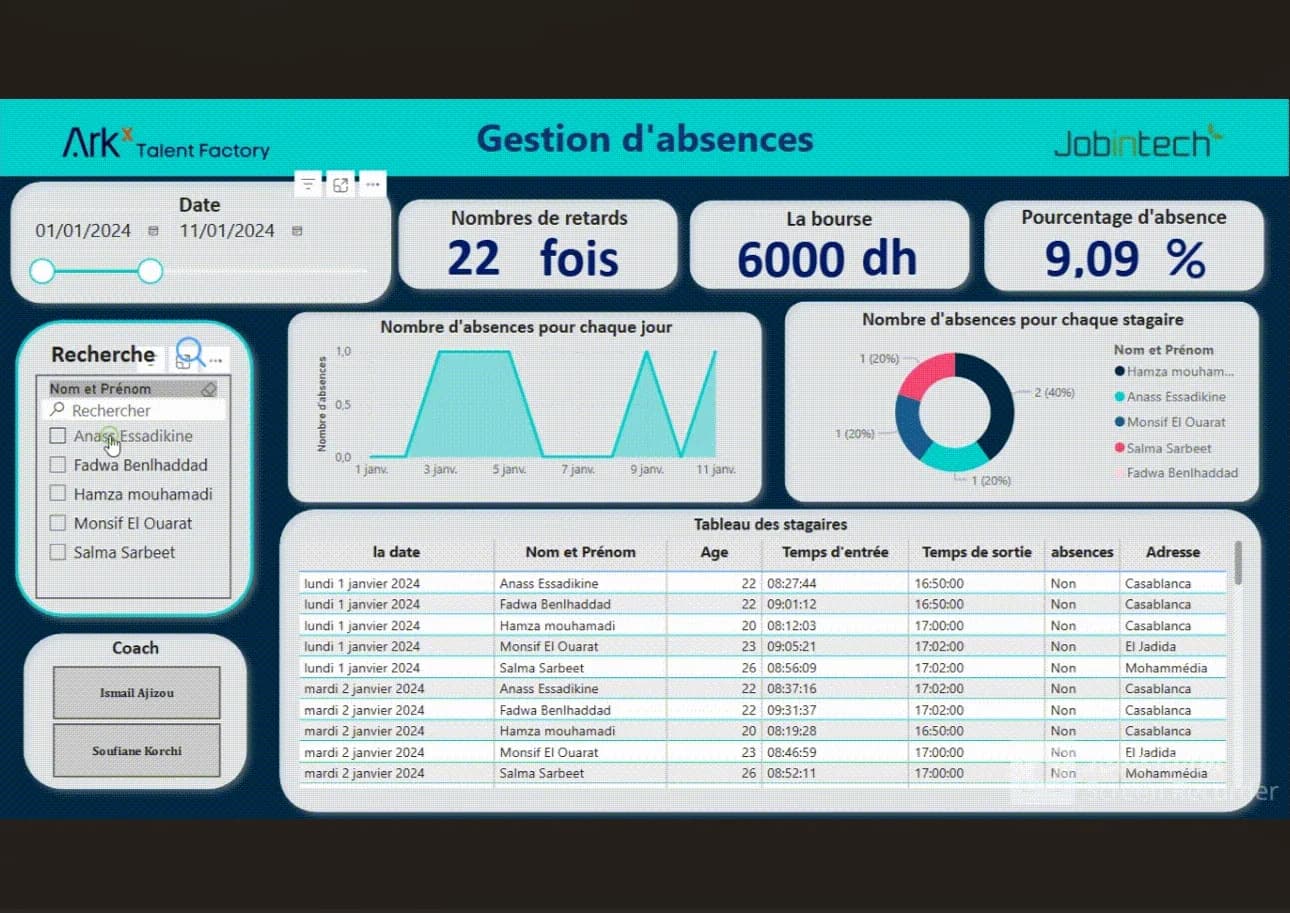
University Housing Management (FSBM)
A secure platform for managing student housing requests, allocations and payments end-to-end.
Frequently asked questions
It's a project-based curriculum that teaches the core computer science foundations software engineers need: Python programming, object-oriented design, data structures, algorithms, complexity analysis (Big O), SQL/databases, and Git/command-line workflows, capped with a portfolio capstone project.
Yes. It has dedicated units on arrays, hash tables, linked lists, stacks, queues, trees, and graphs, plus recursion, sorting algorithms (bubble, merge, quicksort), searching algorithms, and Big O time/space complexity analysis.
Python is the sole language used throughout the path: for syntax, control flow, functions, complex data types, and object-oriented programming.
It's not a university degree, but employers value it as verifiable evidence of structured CS fundamentals (algorithms, complexity, SQL, Git) applied through hands-on projects, which is what technical interviews and take-home tasks actually test for.
It's self-paced and substantial, running from programming fundamentals through a final capstone project. Most learners complete it over several weeks to a few months alongside other coursework or work.