Full-Stack Engineer Career Path: The Skills Behind My MERN and Spring Boot Projects
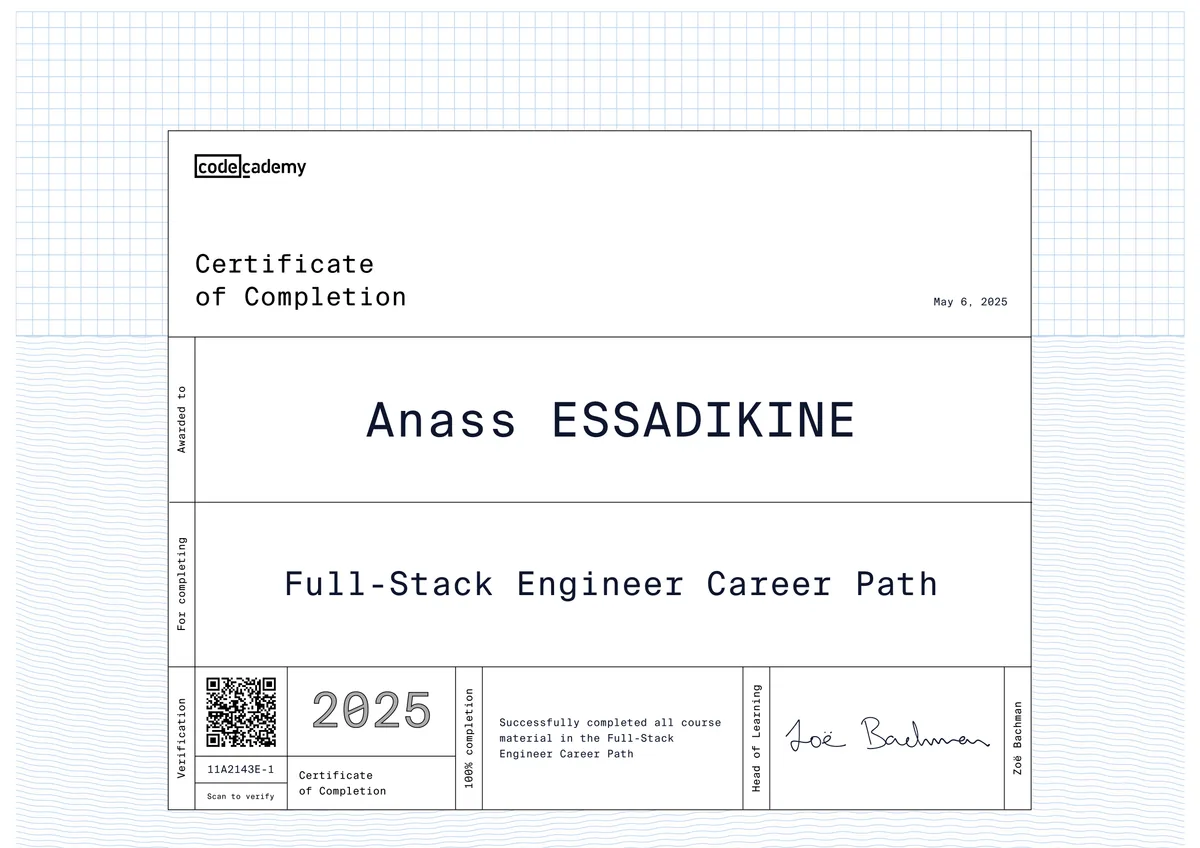
The Full-Stack Engineer Career Path from Codecademy is a project-based credential covering the entire web development stack: markup and styling, JavaScript programming, front-end interfaces, back-end APIs, relational databases, and Git-based version control. It's built around one premise, a full-stack developer needs to be fluent in both what a user sees and what powers it behind the scenes.
For recruiters, this credential signals something specific: the holder has written semantic HTML/CSS layouts, built interactive UIs in React, programmed server logic in Node.js and Express, designed and queried relational databases with SQL, and used Git/GitHub in a collaborative workflow, each validated through graded, portfolio-worthy projects rather than multiple-choice quizzes.
What I learned
Web Foundations: HTML & CSS
Semantic HTML structure and responsive CSS layout using Flexbox and Grid, building static pages that adapt across screen sizes before any JavaScript is introduced.
JavaScript Programming
Core language fundamentals (variables, control flow, functions, arrays and objects) followed by ES6+ syntax, asynchronous programming with promises/async-await, and DOM manipulation.
Git and GitHub
Version control fundamentals: committing, branching, merging, resolving conflicts, and collaborating on a shared repository the way a development team actually works.
Front-End Development with React
Building component-based UIs with JSX, managing state and props, using hooks (useState, useEffect), and handling client-side routing for single-page applications.
Back-End Development with Node.js & Express
Writing server-side JavaScript, building RESTful APIs with Express, handling routing and middleware, and structuring a back end that a front-end app can consume.
Databases and SQL
Relational database design, writing SQL queries and joins, and schema design with PostgreSQL, then connecting a database to a Node/Express back end.
Full-Stack Integration
Connecting a React front end to an Express/Node API and a SQL or NoSQL database into one working application, including basic authentication patterns.
Technical Interview Preparation
Practicing data-structures-and-algorithms problems and mock technical interviews structured around the coding questions full-stack roles typically screen for.
Tools & technologies
- HTML5
- CSS3
- JavaScript (ES6+)
- React
- Node.js
- Express
- Git & GitHub
- SQL
- PostgreSQL
- RESTful APIs
- Command line / Bash
Applied in my projects
The stack this path teaches (React on the front end, Node/Express on the back end, and a database underneath) is exactly what I used to build the Blog Management Application (MongoDB Atlas, Express, Node.js, React), a MERN app with full CRUD and a Material UI/Tailwind interface. The same layered thinking shows up in University Housing Management (FSBM), where I paired a React front end with a Spring Boot/MySQL back end and JWT authentication for a multi-role housing platform. Earlier front-end fundamentals from this path (semantic HTML, CSS, and vanilla JavaScript) are what I first practiced building my own Developer Portfolio Website.
Why this matters for employers
Enterprises don't need to guess whether I can contribute across a stack, this credential confirms I can move between front end and back end without a hand-off gap, which shortens onboarding and reduces the number of specialists needed for a single feature. I can build a UI in React, wire it to a Node/Express API, model and query the underlying database, and ship the result through the Git-based workflows a team already uses. For hiring managers, that means fewer blockers on small-to-mid product teams, faster prototyping for MVPs, and a developer who can read a ticket end-to-end (API, database, and interface) instead of only one layer of it.
Verified certificate
Download the official certificate for this achievement.
- full-stack developer Morocco
- Codecademy Full-Stack Engineer Career Path
- React Node.js Express developer
- MERN stack developer Casablanca
- SQL PostgreSQL developer portfolio
- Git GitHub full-stack workflow
- full-stack web developer for hire
- REST API developer React
- hire full-stack engineer Morocco
This certification is part of my Full-Stack Developer profile. All my credentials are on the certifications page.
Related projects
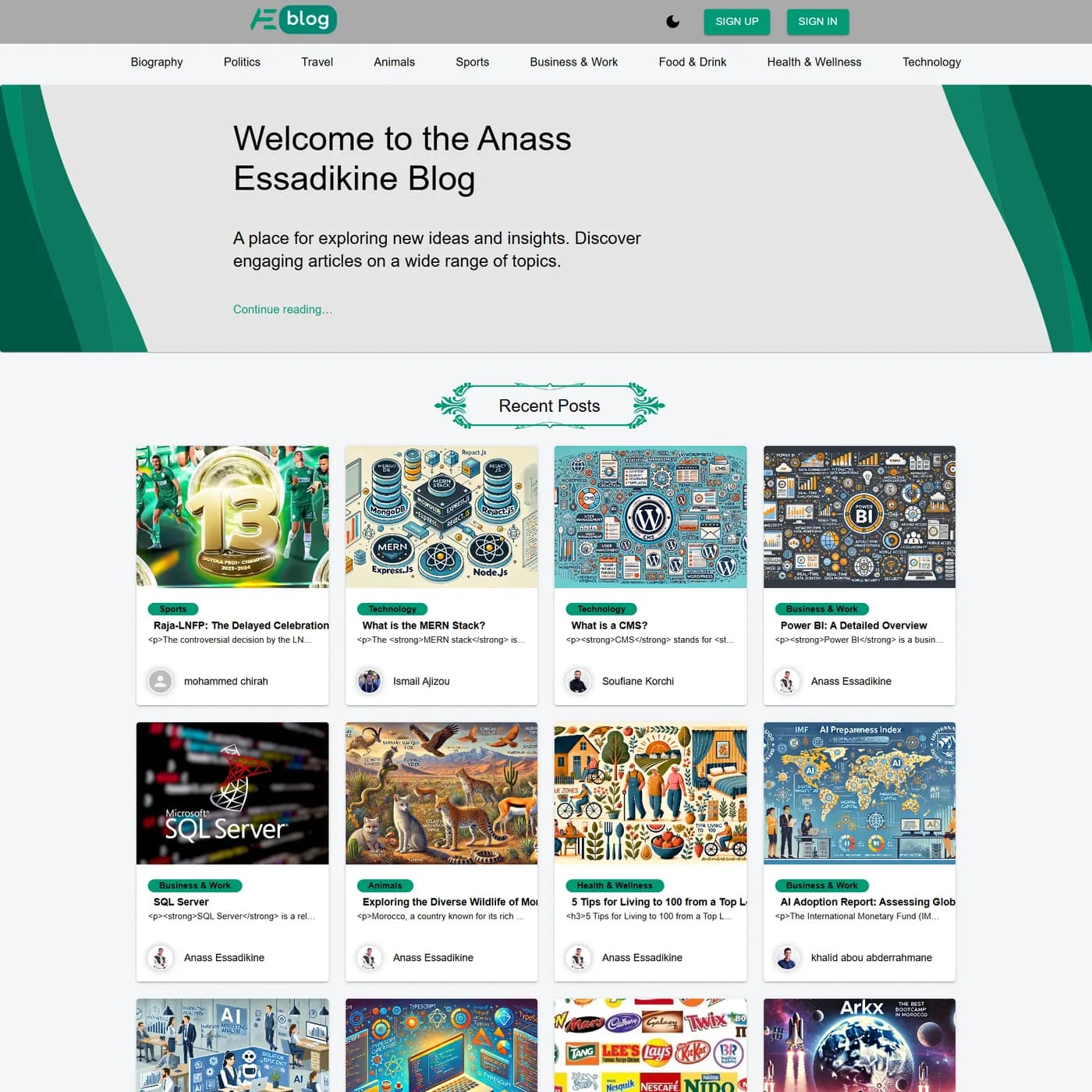
Blog Management Application (MERN)
A complete MERN blogging platform with authentication, a rich-text editor, comments and an admin dashboard with charts.
University Housing Management (FSBM)
A secure platform for managing student housing requests, allocations and payments end-to-end.
Frequently asked questions
It's a structured path covering the full web stack: HTML and CSS for markup and layout, JavaScript (ES6+) for programming logic, Git/GitHub for version control, React for front-end interfaces, Node.js and Express for back-end APIs, and SQL/PostgreSQL for relational databases, tied together with hands-on portfolio projects.
Codecademy career paths are recognized as evidence of practical, project-based skill-building rather than pure theory. Employers generally value the certificate alongside a visible portfolio of real projects built with the same stack, which is why I pair the credential with shipped applications like the MERN blog platform and the Spring Boot/React housing system.
Codecademy estimates roughly 6 months at a part-time pace, though it varies with prior programming experience. It's structured as a sequence of courses and graded projects rather than a single short course.
Yes. It's explicitly full-stack: front-end work with HTML, CSS, JavaScript, and React, plus back-end work with Node.js, Express, and SQL databases, including how to connect the two layers into one working application.
A front-end-only path stops at UI and client-side JavaScript. This career path continues into server-side routing, REST API design, database schemas, and full-stack integration, which is what qualifies someone for full-stack roles rather than front-end-only positions.