What I Learned Earning Codecademy's Data Scientist: NLP Specialist Certification
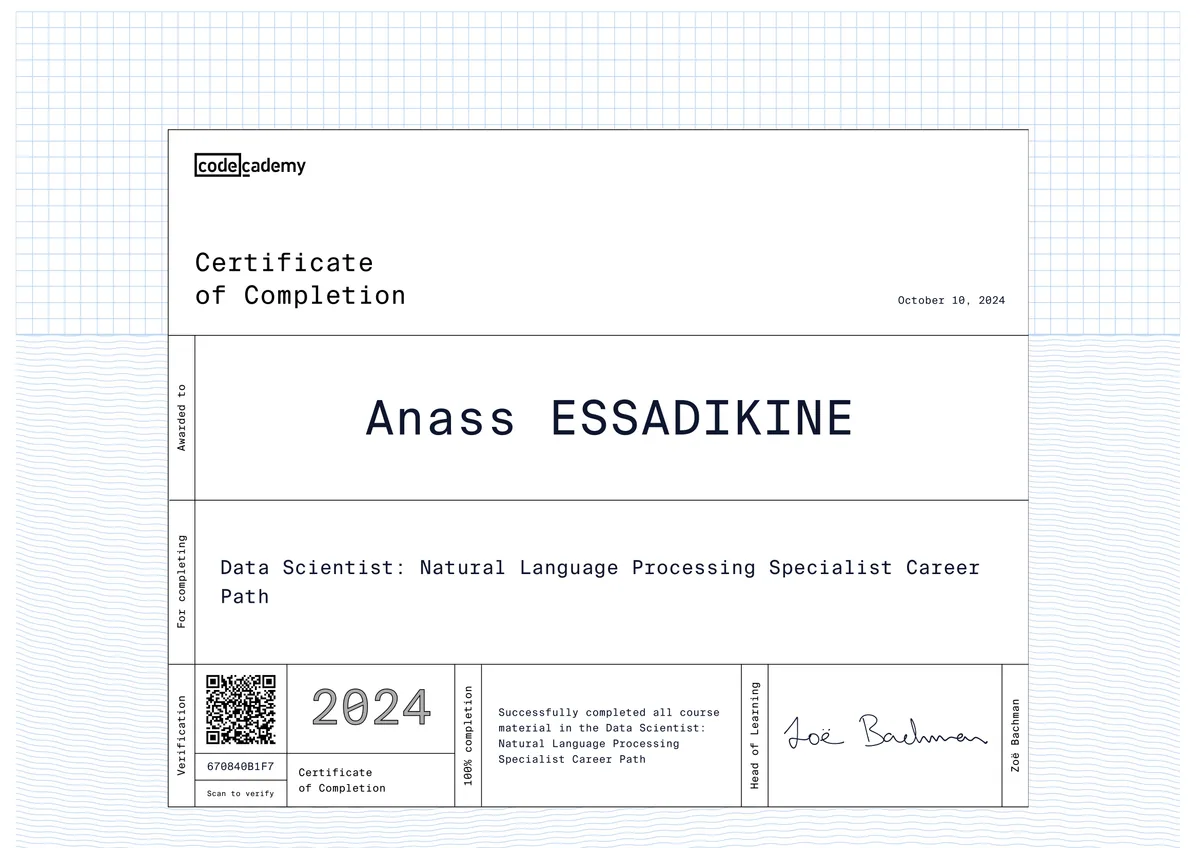
The Data Scientist: Natural Language Processing Specialist career path is Codecademy's full data-science curriculum with a dedicated NLP specialization layered on top: it opens with Python, SQL, and Pandas foundations, moves through supervised and unsupervised machine learning, then finishes with a focused NLP track — text preprocessing, language parsing, language quantification (bag-of-words, TF-IDF, word embeddings), and neural text generation with Seq2Seq/LSTM models. It's a 31-unit, ~100-hour program built around real portfolio projects rather than passive video-watching.
NLP is one of the fastest-growing demand areas in enterprise software because so much business value sits in unstructured text — support tickets, reviews, contracts, chat logs, emails. Companies need engineers who can turn that raw text into structured signals a model can act on: routing tickets, scoring sentiment, extracting entities, or powering a chatbot. This certification is my evidence that I can do that end-to-end, from cleaning dirty text to shipping a working model.
What I learned
1Data Science Foundations: Python, SQL & Pandas
The path's base courses covering Python 3 fundamentals, SQL querying, and Pandas for data wrangling — the same toolkit every later NLP module builds on.
2Getting Started with Natural Language Processing
A field overview of where NLP is used in industry — search, translation, chatbots, sentiment analysis — plus the core Python toolkit (NLTK, spaCy, Gensim) used throughout the rest of the path.
3Text Preprocessing
Cleaning raw text with regular expressions and NLTK: tokenization, stemming, lemmatization, and stopword removal to turn unstructured text into model-ready data.
4Language Parsing
Applying regex and parsing techniques such as part-of-speech tagging to extract grammatical structure and meaning from sentences.
5Language Quantification: Bag-of-Words, TF-IDF & Word Embeddings
Representing text numerically for machine learning — word-count vectors, TF-IDF weighting, and dense word embeddings — to measure semantic similarity between documents.
6Text Generation with Neural Networks
Building Seq2Seq and LSTM neural networks in TensorFlow/Keras for sequence tasks such as machine translation and text generation.
7NLP Portfolio Project
An independent capstone applying the full pipeline — preprocessing, quantification, and modeling — to a real text dataset, from raw text to a working model.
Tools & technologies
Applied in my projects
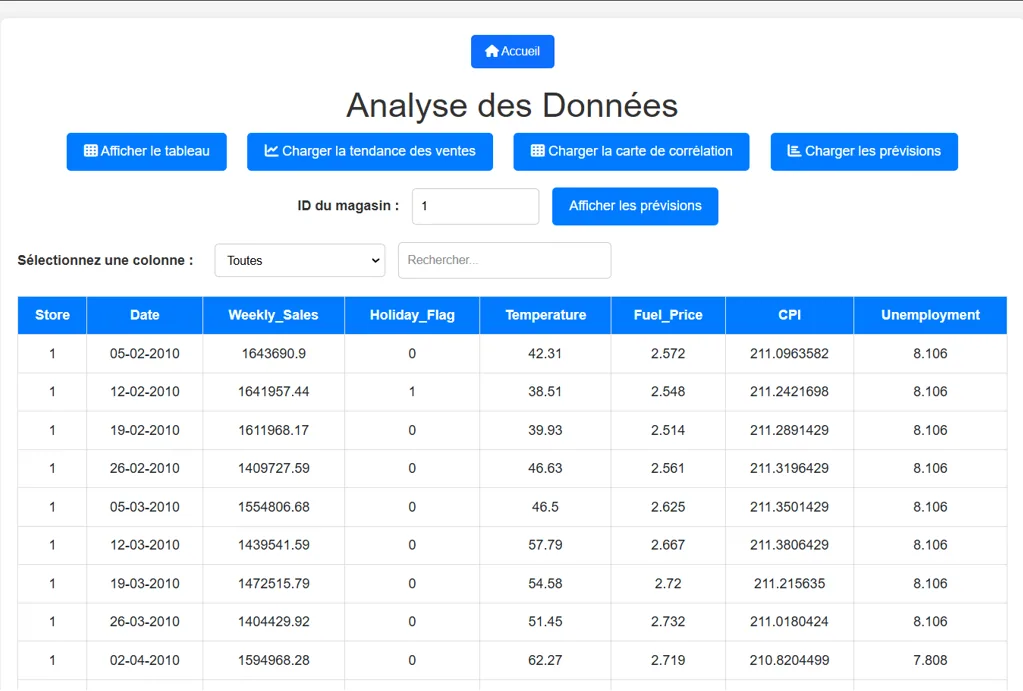
This certification's Python data-science stack — Pandas, NumPy, scikit-learn, and Matplotlib — is the same foundation behind my Sales Prediction App with Django & ML, where I used Pandas and scikit-learn to clean data and train a predictive model, then shipped it through a Django interface. The NLP specialization extends that exact pipeline — ingest, clean, quantify, model — from structured sales data to unstructured text, which is the skill set I'd bring to any role involving support-ticket triage, review analysis, or document automation.
Why this matters for employers
For employers, this certification signals that I can handle the messiest part of applied data science: unstructured text. I take raw, inconsistent text — logs, tickets, reviews, chat transcripts — and turn it into clean, structured features using regex, NLTK, and spaCy, then quantify it with TF-IDF or embeddings and feed it into scikit-learn or TensorFlow models. Combined with my full-stack background (Spring Boot, React, Django), that means I can build the NLP model and wire it into a production application end-to-end — the kind of hire who shortens the gap between a data-science prototype and a deployed feature.
Verified certificate
Download the official certificate for this achievement.
Related projects
 AI / Data Science2024
Sales Prediction App with Django & ML
A predictive analytics web app that forecasts sales and visualizes results through an interactive interface.
Frequently asked questions
It's a 31-unit, roughly 100-hour Codecademy career path that combines full data-science foundations (Python, SQL, Pandas, machine learning) with a specialized NLP track covering text preprocessing, language parsing, word embeddings, and neural text generation, capped with hands-on portfolio projects.