JavaScript Programming Essentials: What Meta's Certification Actually Teaches
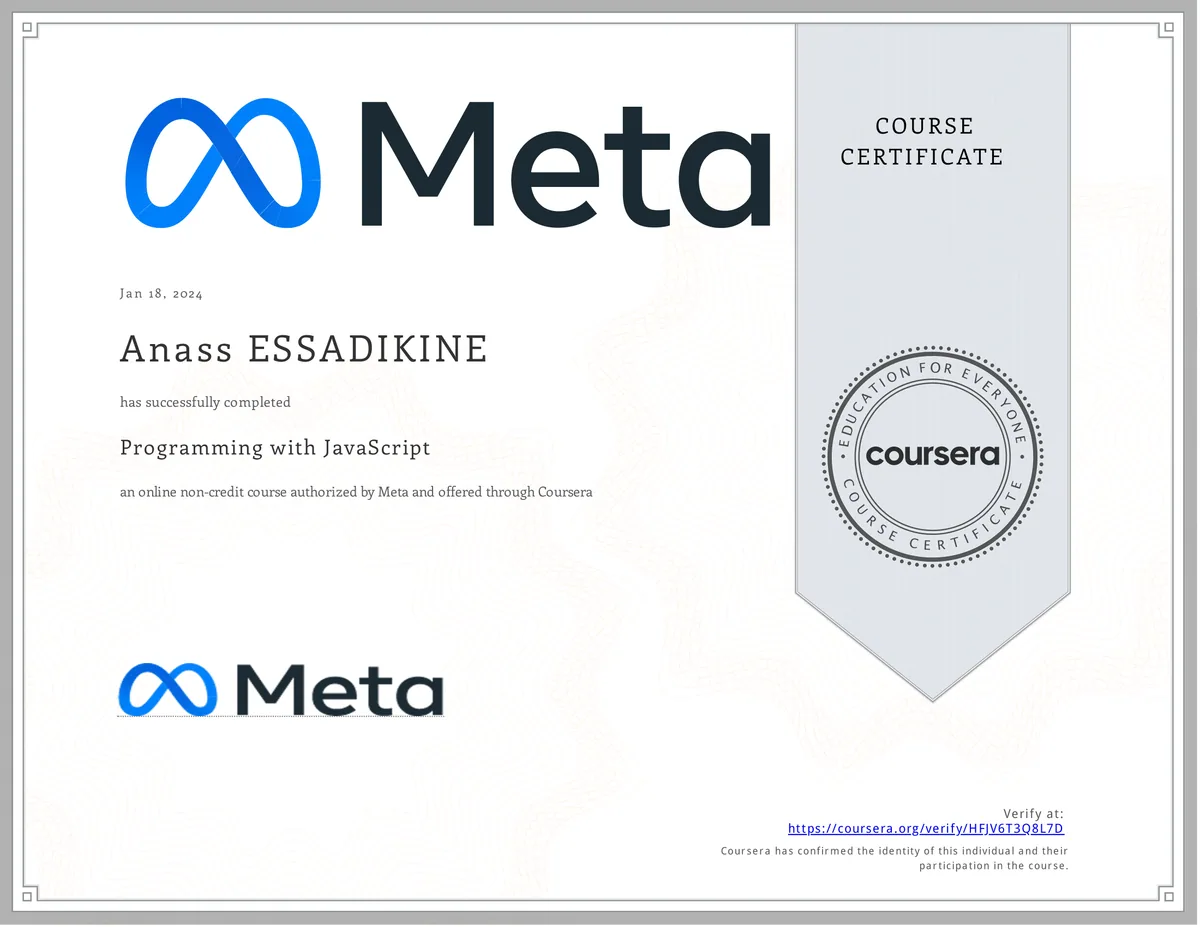
JavaScript Programming Essentials is Meta's foundational JavaScript course on Coursera, and it's the credential I completed to formalize core language skills I already use daily: variables, control flow, functions, objects, arrays, and the debugging habits that keep production code stable. The curriculum is developed by Meta engineers and stays close to real development practice rather than isolated tutorial exercises.
JavaScript still runs the browser tab of nearly every product a company ships, and now runs the server too through Node.js: so a developer who's rock-solid on the fundamentals moves between front-end, back-end, and full-stack work without relearning the language each time. For hiring managers, a Meta-issued JavaScript credential is a fast, low-risk signal that a candidate's basics (syntax, error handling, functional patterns) are verified rather than self-reported.
What I learned
JavaScript Fundamentals & Running Code in the Browser
Why JavaScript powers the modern web, how to execute scripts in the browser console and inside HTML pages, and core syntax: variables (var, let, const), primitive data types, and template literals.
Operators, Conditionals & Loops
Arithmetic, comparison, and logical operators combined with if/else, switch statements, and for/while loops to control program flow and solve short coding exercises.
Functions, Objects & Arrays
Function declarations, expressions, and arrow functions alongside object literals and the array methods (map, filter, forEach, reduce) used to transform and query data in real applications.
Error Handling & Defensive Programming
Distinguishing undefined, null, and empty values; using try/catch/finally blocks; and writing code that anticipates bad input instead of crashing on it.
Functional & Object-Oriented Patterns
Scope and closures, the practical differences between var, let, and const, ES6 classes and inheritance, and modern spread/rest syntax for cleaner, reusable code.
Node.js, npm & Testing with Jest
Setting up a Node.js environment, managing dependencies through npm and package.json, and writing unit tests with Jest to verify code behaves as expected before it ships.
Final Graded Project
A capstone exercise applying every concept from the course to build a working, end-to-end application, graded against a rubric that mirrors how real features get reviewed on the job.
Tools & technologies
- JavaScript (ES6+)
- Node.js
- npm
- Jest
- Chrome DevTools
- Git & GitHub
- Visual Studio Code
Applied in my projects
These fundamentals show up directly in my own work. Static Movie App: Cinema Web is built with plain HTML, CSS, and JavaScript, so its DOM interactions and control-flow logic come straight out of this course's core modules. Blog Management Application runs JavaScript end-to-end, a Node.js/Express API on one side and a React front end on the other, which is exactly the npm-managed, error-handled JavaScript this certification teaches. And my Personal Portfolio, Developer Website leans on the same vanilla JS patterns (event handling, DOM manipulation) to power its interactive UI without a framework doing the work for me.
Why this matters for employers
For an employer, this certification proves my JavaScript isn't limited to copy-pasted framework boilerplate: I can write, debug, and test vanilla JS, structure a Node.js backend, and manage dependencies with npm. That range, from a React front end to an Express API, plus habits like defensive error handling and Jest-based unit testing, cuts onboarding time and code-review overhead for teams that need a genuinely full-stack-capable developer, not just someone who wires up pre-built components.
- JavaScript Programming Essentials certification
- Meta JavaScript course
- hire JavaScript developer Morocco
- full-stack JavaScript developer Casablanca
- Node.js developer Morocco
- Node.js npm Jest developer
- ES6 JavaScript skills
- Coursera Meta certificate
- JavaScript developer for hire
This certification is part of my Full-Stack Developer profile. All my credentials are on the certifications page.
Related projects

Blog Management Application (MERN)
A complete MERN blogging platform with authentication, a rich-text editor, comments and an admin dashboard with charts.
Frequently asked questions
It's a Coursera course from Meta covering core JavaScript (syntax, control flow, functions, objects and arrays, error handling, and ES6 patterns) plus an introduction to Node.js, npm, and Jest testing, capped by a graded final project.
Yes. Meta developed this Coursera credential as part of its own developer training pipeline, so recruiters generally treat it as a verified baseline in JavaScript fundamentals, especially alongside real shipped projects that show the skills in practice.
Both. Alongside core browser-facing JavaScript (syntax, control flow, functions, objects) it introduces Node.js, npm package management, and unit testing with Jest, so it maps to front-end and back-end JavaScript work.
This is a single foundational course, not the full multi-course professional certificate. It establishes core JavaScript competency, which the broader program then builds on with dedicated HTML/CSS, React, and UX courses.
Enough to ship working interactive features: form validation, dynamic DOM updates, calculator-style tools, small data-driven apps, and Node.js scripts backed by npm packages and Jest tests.