Docker Certification: Working with Containers, From Course to Production CI/CD
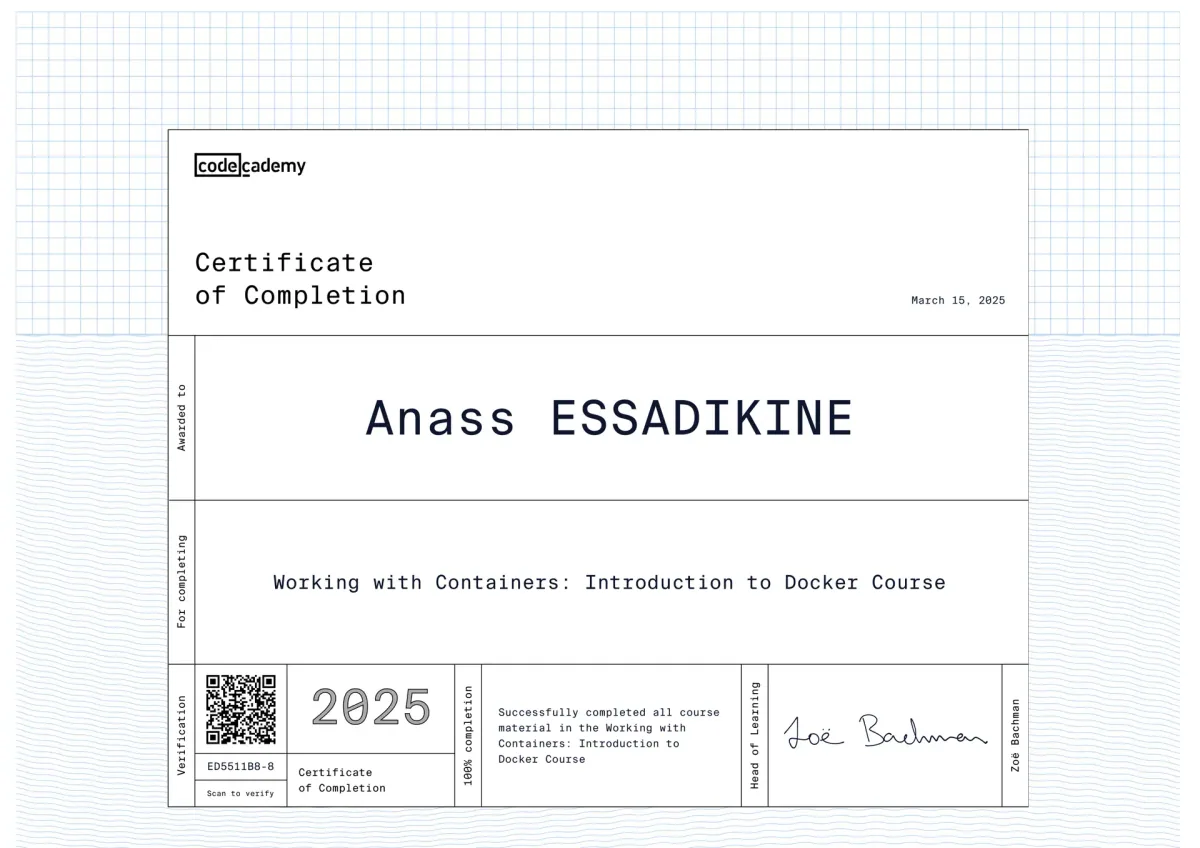
"Working with Containers: Introduction to Docker" is a Codecademy course certificate confirming I can explain and apply Docker's core containerization model — not just define the buzzwords. It's a focused, hands-on credential covering the services Docker provides, the standard Docker workflow, and the practical mechanics of building and managing containers, issued directly by Codecademy on completion.
Containers matter in industry because they solve the "it works on my machine" problem at scale: an image built once runs identically on a laptop, a CI runner, or a production cloud server. Recruiters screening for DevOps, cloud, or full-stack roles increasingly expect Docker fluency as table stakes — this certification is the documented starting point for that skill, one I've since carried into a real automated CI/CD deployment.
What I learned
1Docker Services & Containerization Overview
Explains what Docker is and the services it provides — packaging an application with its dependencies into a portable, isolated container instead of relying on a full virtual machine.
2The Docker Workflow
Walks through the standard end-to-end workflow: writing a Dockerfile, building it into an image, running that image as a container, and distributing it through a registry.
3Provisioning Docker Resources
Covers setting up the Docker environment needed to create and run containers, and provisioning the resources a container depends on.
4Anatomy of a Docker Image
Breaks down the elements that make up a Docker image — layers, base images, tags, and image IDs — and how they combine into a reusable build artifact.
5Writing a Dockerfile
Covers the purpose and structure of a Dockerfile: the instruction set used to define reproducible, versioned build steps for an image.
6Building a Docker Image
Hands-on practice using the Docker build process to compile Dockerfile instructions into a runnable image ready to ship or run locally.
7Managing Docker Resources
Covers the commands and practices for listing, stopping, and removing containers and images, and managing the container lifecycle responsibly.
8Real-World Docker Use Cases
Identifies scenarios where Docker is the appropriate tool — such as consistent environments and deployment pipelines — versus when it isn't needed.
Tools & technologies
Applied in my projects
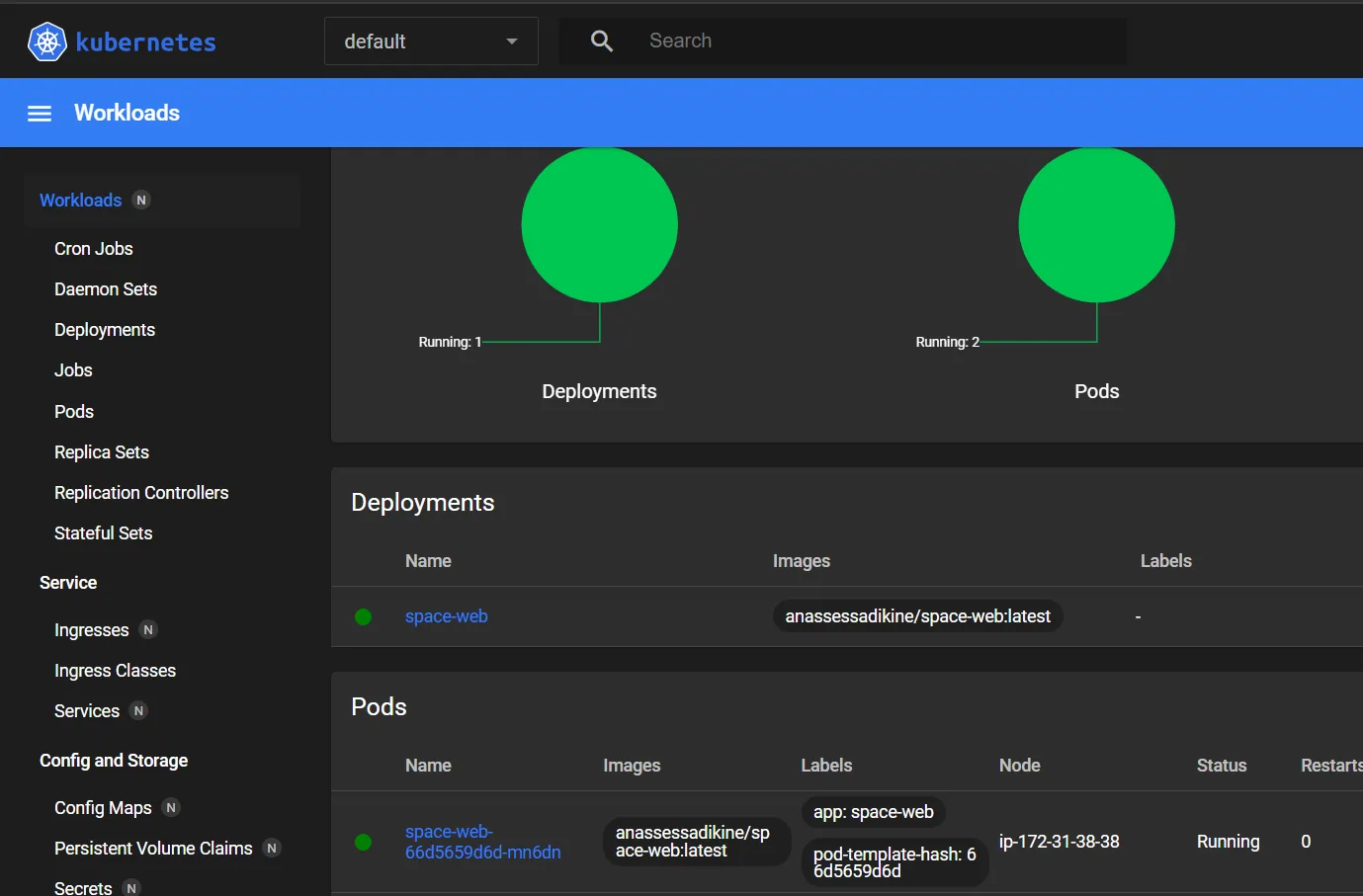
The clearest application of this certification is my Cloud Deployment with Automated CI/CD project, where I containerized a React/Vite frontend with a Dockerfile, built and pushed versioned images to Docker Hub, and fed them into a Jenkins pipeline that deploys onto a K3s cluster provisioned with Terraform and configured with Ansible on AWS. Every step in that pipeline — image build, tagging, registry push, container orchestration — traces directly back to the workflow, image structure, and resource-management concepts this course covers.
Why this matters for employers
Containers are how modern software actually ships — from microservices on Kubernetes to CI/CD pipelines that build once and deploy anywhere. Holding this certification signals that I understand Docker at the level a hiring manager cares about: writing a correct Dockerfile, building and tagging an image, managing container lifecycle, and knowing when containerization is the right architectural choice versus overkill. Paired with hands-on infrastructure work — Jenkins pipelines, Docker Hub registries, K3s orchestration, and Terraform/Ansible provisioning on AWS — it tells an employer I can be productive in a DevOps or cloud-native team from day one, not just recite Docker terminology in an interview.
Related projects
 Cloud / DevOps2024
Cloud Deployment with Automated CI/CD
An end-to-end CI/CD pipeline that builds, containerizes and deploys a React app to AWS automatically.
Frequently asked questions
It's a beginner-level, roughly one-hour Codecademy course (no prerequisites) that teaches the Docker services model, the Docker workflow, how images and Dockerfiles are structured, and how to manage Docker resources day to day.