Introduction to Kubernetes Certification: Container Orchestration Fundamentals
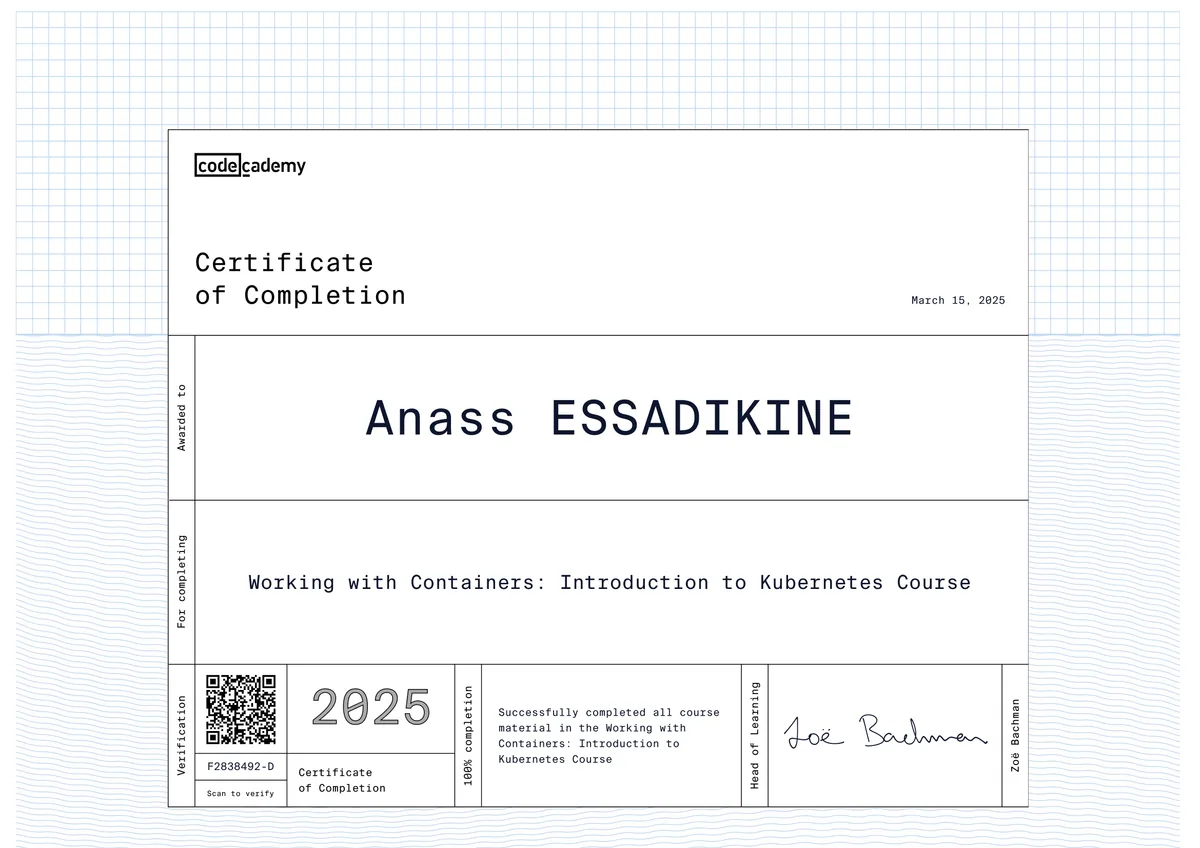
"Working with Containers: Introduction to Kubernetes" is an external course on Codecademy, delivered through expert-led video instruction and capped with a certificate of completion. It's a focused, beginner-level introduction to Kubernetes — the container orchestration platform that has become the industry default for running containerized applications at scale — covering the terminology, workflow, security basics, and use cases a developer needs before touching a production cluster.\n\nKubernetes shows up in almost every serious DevOps and cloud job description today, because containers alone don't solve scaling, healing, or scheduling — orchestration does. Completing this course gave me a structured vocabulary and mental model for cluster architecture that I now recognize directly in the tooling I already use, like K3s, Docker, and Terraform-provisioned infrastructure in my own deployment pipeline.
What I learned
1Kubernetes Fundamentals & Terminology
Introduces the core vocabulary of Kubernetes — clusters, nodes, pods, deployments, and services — and explains the problem orchestration solves for teams running containerized software at scale.
2The Container-to-Cluster Workflow
Walks through the standard workflow for packaging software into containers and deploying it onto a Kubernetes cluster, from image build through rollout.
3Securing a Kubernetes Cluster
Covers the practices and controls involved in securing a live cluster, including the operational risks orchestration introduces once workloads are running in production.
4Kubernetes Use Cases
Surveys real-world scenarios where orchestration adds value — scaling applications on demand, coordinating multi-container systems, and automating recovery from failure.
5Kubernetes vs. Docker
Clarifies where Docker's role as a container runtime ends and Kubernetes' role as an orchestrator begins, and how the two are typically combined in a production stack.
Tools & technologies
Applied in my projects
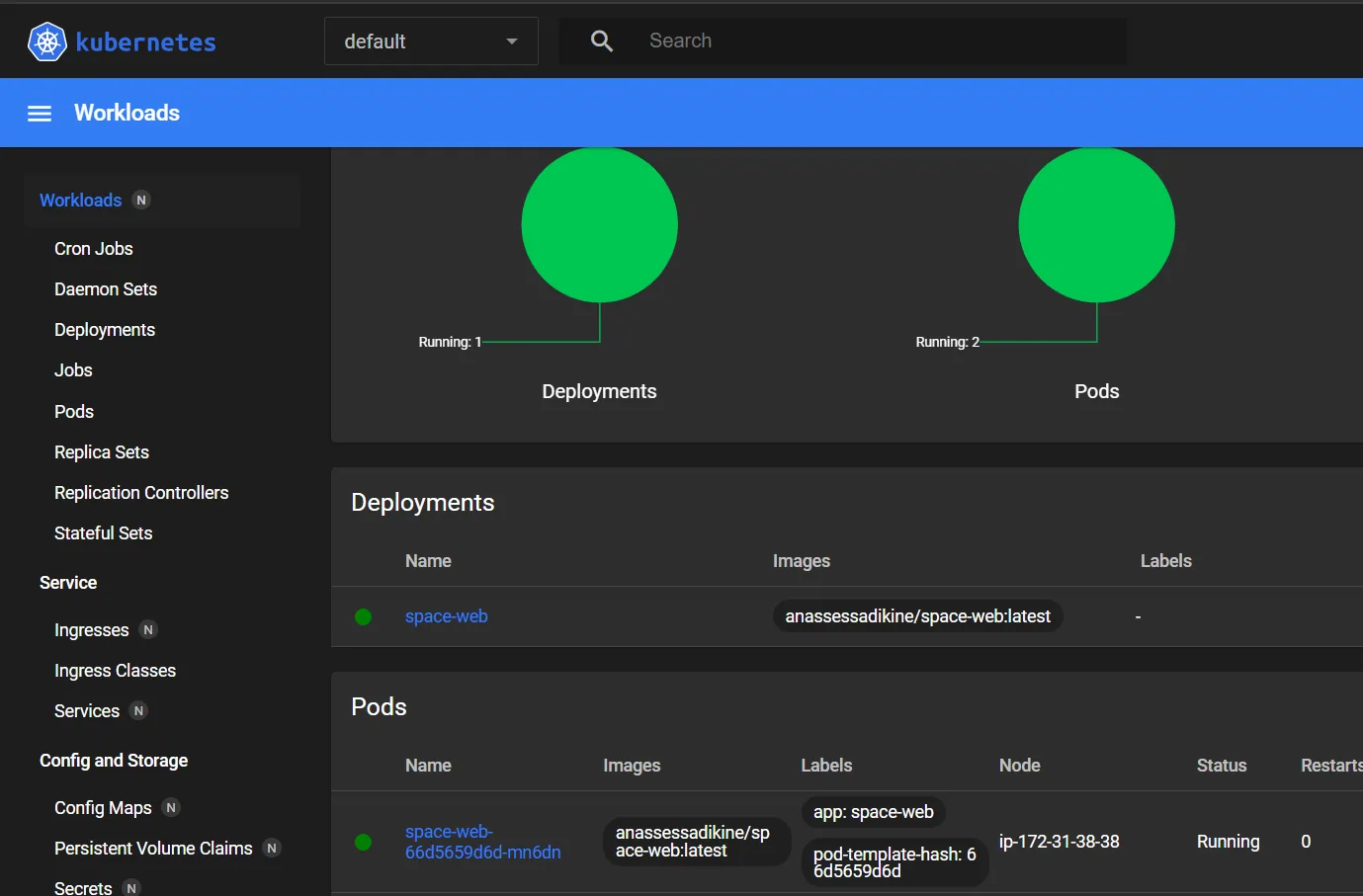
This certification maps directly onto my Cloud Deployment with Automated CI/CD project, where I containerize a React/Vite front end with Docker, push images to Docker Hub, and orchestrate them on a K3s cluster — a lightweight, certified Kubernetes distribution — provisioned with Terraform and configured with Ansible, all triggered through a Jenkins pipeline on AWS. The course's coverage of cluster terminology, the container-to-cluster workflow, and cluster security gave me the conceptual grounding to reason about why that pipeline is structured the way it is, not just how to run the commands.
Why this matters for employers
For hiring managers, this credential signals I understand container orchestration as a system, not a buzzword — the difference between a developer who can docker build an image and one who can reason about how that image gets scheduled, scaled, secured, and healed once it's running in a cluster. Paired with hands-on infrastructure work using Docker, K3s, Terraform, Ansible, and Jenkins on AWS, it positions me as a full-stack developer based in Morocco who can carry an application from code to a running, orchestrated deployment — a skill set enterprises increasingly expect from DevOps, cloud, and backend engineering candidates, not just dedicated infrastructure teams.
Related projects
 Cloud / DevOps2024
Cloud Deployment with Automated CI/CD
An end-to-end CI/CD pipeline that builds, containerizes and deploys a React app to AWS automatically.
Frequently asked questions
It's a beginner-level, video-based course (about an hour long) covering Kubernetes terminology, the container-to-cluster deployment workflow, cluster security basics, common Kubernetes use cases, and a direct comparison between Kubernetes and Docker.