AI Use Cases for Moroccan Businesses: A Practical Guide by Sector
Artificial intelligence is useful to a Moroccan company when it removes a repetitive task or answers a real business question. Here are realistic use cases by sector, how to start and what to watch on data protection.
What can AI actually do for a Moroccan company?
For most Moroccan companies, AI pays off in four places: answering customers in several languages, reading documents (invoices, forms, contracts) instead of retyping them, forecasting sales or demand, and answering employees' questions from internal documents. These are narrow, measurable tasks, which is exactly why they work.
What rarely works is a vague "AI strategy" without a concrete process behind it. The right question is not "how do we use AI?" but "which repetitive task costs us the most time or errors, and do we have the data to automate it?"
Which AI use cases fit which sector?
The table below lists realistic starting points. They are examples of what is technically feasible today, not case studies of specific companies.
| Sector | Use case | Data needed | Difficulty |
|---|---|---|---|
| Banking & insurance | Triage of customer emails and claims, document checks (KYC files) | Historical emails, scanned documents | Medium (compliance-heavy) |
| Telecom | Multilingual support assistant, ticket classification | Support tickets, FAQ, offers catalogue | Medium |
| Retail & e-commerce | Demand forecasting, product description generation, WhatsApp/website chatbot | Sales history, product catalogue | Low to medium |
| Industry & mining | Predictive maintenance, anomaly detection on sensor data, technical document search | Sensor time series, maintenance reports | High |
| Logistics & transport | Delivery time estimation, extraction from delivery notes | GPS/tracking data, scanned notes | Medium |
| Public sector & administrations | Assistant answering from regulations and procedures, form processing | Official texts, procedure guides | Medium (sensitive data) |
| SMEs & services | Quote/invoice extraction, email drafting, prospecting automation | Emails, PDFs, spreadsheets | Low |
How does AI handle customer service in French, Arabic and Darija?
Modern large language models (LLMs) understand French and Modern Standard Arabic well. Darija is harder: it is mostly written in Latin script with numbers ("3", "7", "9") or in Arabic script, with heavy code-switching with French. Models handle it reasonably for understanding, less reliably for writing.
A realistic setup:
- The assistant classifies each incoming message (complaint, order status, billing, other) and detects the language.
- Simple, frequent questions (opening hours, order status, documents to provide) get an answer generated from validated content.
- Everything else is routed to a human with a summary, so the agent does not reread the whole thread.
Here is a minimal Python example that classifies a message and returns JSON. It uses the OpenAI SDK, which also works with OpenAI-compatible providers through base_url:
import json
from openai import OpenAI

client = OpenAI()  # reads OPENAI_API_KEY from the environment

PROMPT = """Classify the customer message.
Return JSON with keys: category (complaint|order_status|billing|other),
language (fr|ar|darija|en), urgent (true|false), summary (one sentence in French)."""

def classify(message: str) -> dict:
    response = client.chat.completions.create(
        model="gpt-4o-mini",
        response_format={"type": "json_object"},
        messages=[
            {"role": "system", "content": PROMPT},
            {"role": "user", "content": message},
        ],
    )
    return json.loads(response.choices[0].message.content)

print(classify("Salam, commande dyali mazal ma wslatnich, 3 jours hadi"))
Test it on a few hundred real (anonymised) messages before going live, and measure how often the category is wrong, especially on Darija.
How can AI process invoices, forms and contracts?
Document processing is often the fastest win for SMEs and back offices. The usual chain:
- OCR turns the scan or PDF into text.
- An LLM extracts structured fields (supplier, ICE, date, amount excl. tax, VAT, total) into JSON.
- Business rules check the result: totals add up, the supplier exists, the date is plausible.
- Doubtful documents go to a human validation queue; the rest is written to the ERP or a spreadsheet.
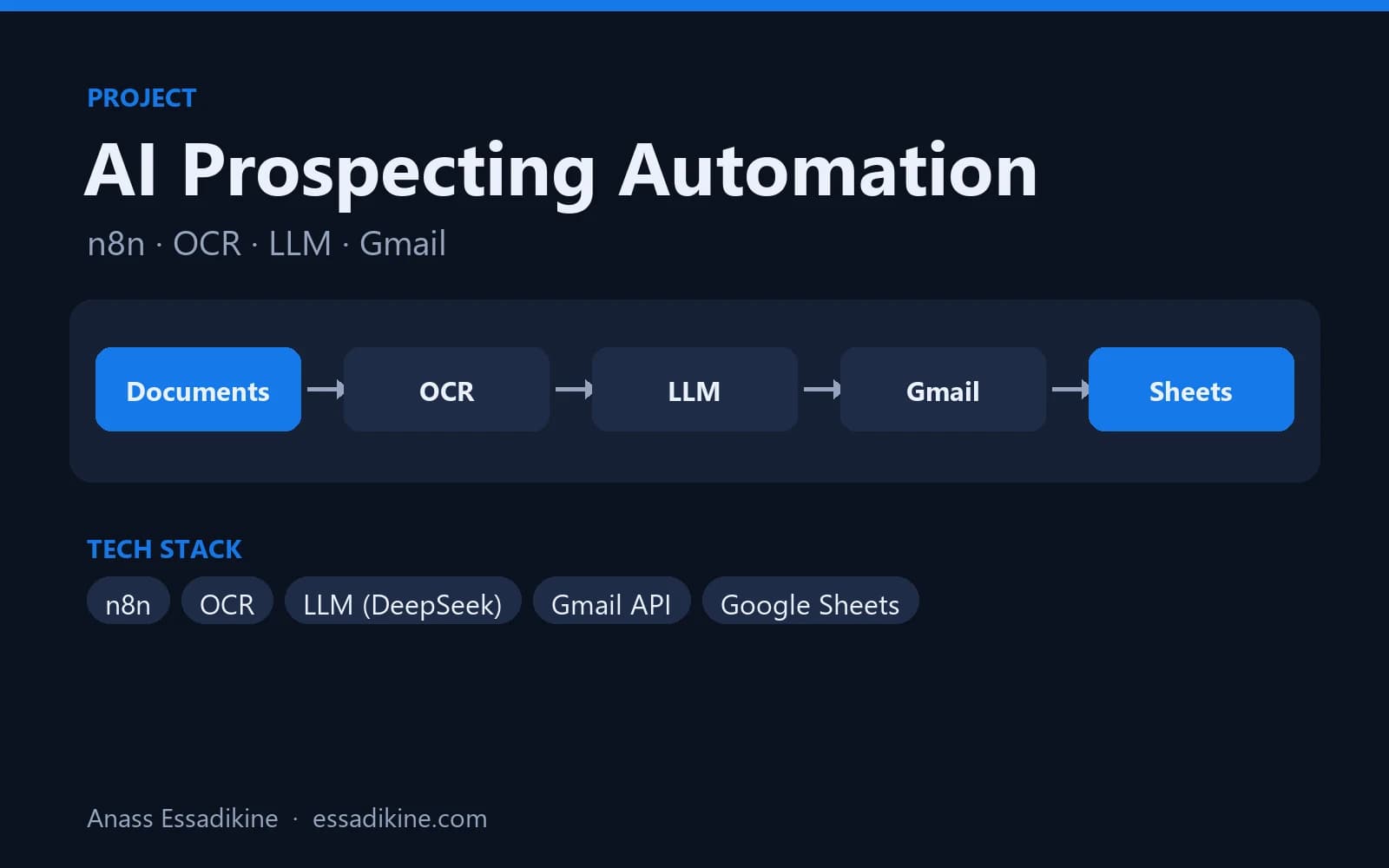
The same pattern powers the AI prospecting automation built with n8n: OCR extracts text, an LLM structures it and drafts an email, and every step is logged in Google Sheets. The tutorial is in automating prospecting with n8n and an LLM.
Can AI forecast sales or demand?
Yes, and here "AI" usually means classic machine learning, not chatbots. With two or three years of clean sales history, a regression or time-series model can estimate next weeks' or months' sales by product, store or region, taking seasonality into account (Ramadan, summer, back-to-school, holidays).
Key conditions:
- Consistent historical data (same product codes over time, no missing months).
- A baseline to beat (for example "same week last year") so you know whether the model adds value.
- Results shown where decisions are made, often a Power BI dashboard.
If you are starting, the beginner machine-learning guide for sales forecasting in Python walks through a complete example.
What is a RAG assistant on internal documents?
RAG (retrieval-augmented generation) lets an LLM answer from your own documents: procedures, HR policies, technical manuals, contracts, regulations. The documents are split into passages, converted into embeddings, and the most relevant passages are given to the model with each question. The answer cites its sources, which makes it verifiable.
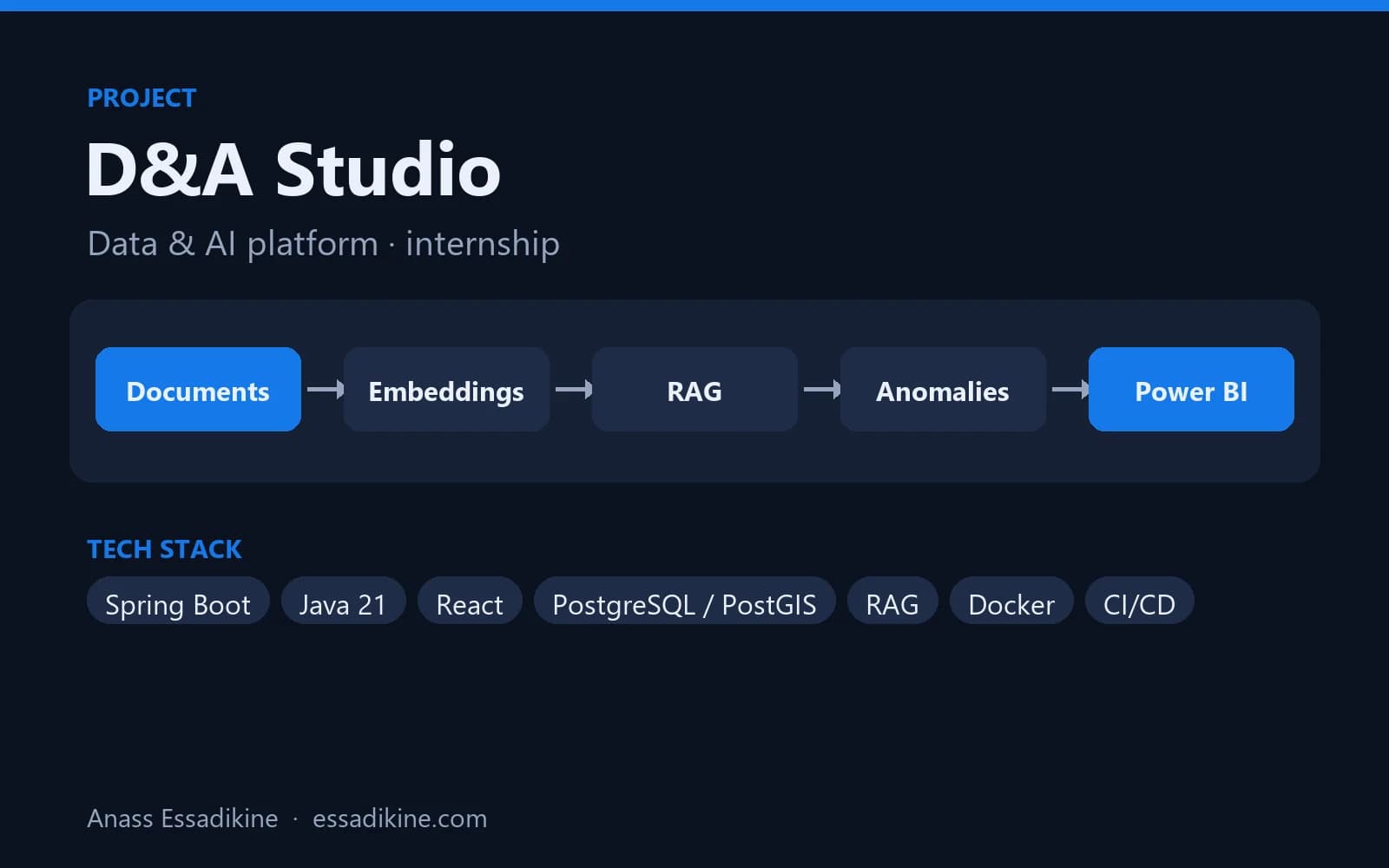
It is a strong fit for organisations with large document bases: banks, insurers, administrations, industrial groups. In the D&A Studio platform, built during an end-of-studies internship in Casablanca, a RAG assistant answers from the company's documents with sources, alongside anomaly detection and Power BI dashboards. The full approach is detailed in building a RAG assistant on company documents.
What about data protection in Morocco (law 09-08 and the CNDP)?
In Morocco, the processing of personal data is governed by law 09-08, and the CNDP (Commission nationale de contrôle de la protection des données à caractère personnel) is the supervisory authority. Depending on the processing, formalities with the CNDP may apply, and transfers of personal data abroad are regulated. This matters for AI because many models run on servers outside Morocco.
Practical precautions (not legal advice; check with a lawyer or your DPO for your case):
- Minimise: send the model only the fields it needs; mask names, CIN numbers, phone numbers and bank details when possible.
- Know where data goes: which provider, which country, whether inputs are kept or used for training.
- Prefer self-hosted or private options for sensitive data (open-weight models on your own servers, or enterprise contracts with clear data terms).
- Log and restrict access: role-based access, audit logs, retention limits.
- Tell users when they are talking to an AI and offer a human alternative.
How do you start an AI project without wasting money?
Step 1 — Pick one process
Choose a frequent, repetitive task with a clear cost: number of emails per day, invoices per month, hours spent searching documents.
Step 2 — Check the data
Is the data accessible, reasonably clean and legally usable? Data preparation is usually most of the work.
Step 3 — Build a small pilot
A few weeks, a limited scope, real users. Measure the result against the current process (time saved, error rate, response time).
Step 4 — Keep a human in the loop
Start with AI that suggests and humans who validate. Automate fully only what has proved reliable.
Step 5 — Industrialise
Monitoring, access control, cost tracking, and documentation, so the solution survives beyond its first author.
Conclusion
AI is useful to Moroccan companies when it is applied to a specific process with available data: multilingual customer service, document processing, forecasting and RAG assistants are the most mature options today. Start small, measure, protect personal data and keep people in control. To see the kind of data and AI work involved, have a look at the Data & AI Engineer profile or the AI automation and RAG service.

Related projects
 AI & AutomationInternship · 2026
D&A Studio — Data & AI Platform (PaaS)
A platform that brings geospatial tracking data, an AI assistant on company documents, anomaly detection and BI dashboards into one place.
 AI & AutomationPersonal project · 2025
AI Prospecting Automation with n8n
An end-to-end workflow that reads documents with OCR, writes personalised emails with an LLM, sends them through Gmail and tracks everything in Google Sheets.
Frequently asked questions
It depends mainly on scope and data quality. A simple automation (for example email or document processing) is a small project, while a RAG assistant connected to several internal systems or a forecasting model in production requires more work. A short pilot is the best way to estimate the real cost before committing.