Full-Stack Developer Roadmap 2026: Skills, Stages and Portfolio
A stage-by-stage roadmap to become a full-stack developer in 2026, from HTML and JavaScript to APIs, databases, Docker and AI-assisted development, with portfolio advice and Moroccan job market context.
A full-stack developer builds both sides of a web application: the interface users see (front-end), the server and API behind it (back-end), the database, and the deployment pipeline. In 2026 the realistic roadmap is: web fundamentals, one front-end framework, one back-end stack, SQL, Git and Docker, then AI-assisted development on top. Depth in one stack beats a long list of tools you have only touched.
What does a full-stack developer actually do?
In day-to-day work, "full-stack" rarely means being an expert in everything. It means being able to take a feature from the database to the screen without waiting for three other people:
- design a table and the query that reads it;
- expose it through a REST API with validation and authentication;
- build the screen that calls the API, with loading and error states;
- ship it with a container and an automated pipeline.
Companies value this profile because one person can understand a bug that crosses layers. The trade-off is that you need solid basics everywhere and real depth in at least one area.
What skills does a full-stack developer need in 2026?
The table below summarises the roadmap by stage. Treat the durations as rough orders of magnitude for someone studying consistently; they vary a lot with prior experience and available time.
| Stage | Area | Core skills | Proof to build |
|---|---|---|---|
| 1 | Web fundamentals | HTML, CSS, modern JavaScript, HTTP, browser DevTools, Git | A responsive static site deployed online |
| 2 | Front-end | TypeScript, React (components, state, effects), routing, forms, fetching data, Tailwind or CSS modules | A React app that consumes a public API |
| 3 | Back-end | Node.js/Express or Java/Spring Boot, REST design, validation, authentication (JWT, sessions), error handling | Your own REST API with CRUD and auth |
| 4 | Databases | SQL (joins, indexes, transactions), PostgreSQL or MySQL, an ORM (JPA/Hibernate, Prisma), basic NoSQL (MongoDB) | A schema with relations and migrations |
| 5 | DevOps | Linux basics, Docker, environment variables, CI/CD (GitHub Actions, Jenkins), a cloud VM or PaaS, HTTPS | Automatic deployment on every push |
| 6 | AI-assisted dev | Using coding assistants, reviewing generated code, writing tests, calling LLM APIs, basic RAG | A feature that uses an LLM, with tests |
Stage 1 — Web fundamentals
Skip nothing here. Understand how a request travels from the browser to a server, what status codes mean, how the DOM works and why CSS layout behaves the way it does. Learn Git from day one and commit every exercise. The MDN Learn web development curriculum is free and reliable.
Stage 2 — Front-end with React and TypeScript
React remains the most requested front-end library in job posts, and TypeScript is now expected in most professional codebases. Focus on:
- components and props, state and effects;
- fetching data and handling loading, empty and error states;
- forms and validation;
- a meta-framework such as Next.js once the basics are solid (server rendering, routing, SEO).
Stage 3 — Back-end: pick one stack and go deep
Two common choices:
- Node.js (Express, NestJS): same language as the front-end, fast to start.
- Java with Spring Boot: very common in banks, insurance, telecoms and IT service companies, strong typing and a mature ecosystem.
Whichever you choose, learn REST conventions, input validation, authentication with roles, pagination, and how to structure code in layers (controller, service, repository). A hands-on starting point is the Spring Boot + React tutorial.
Stage 4 — Databases
SQL is the skill that ages best. Practise joins, aggregations, indexes and transactions on PostgreSQL or MySQL, then learn how your ORM translates code into queries (and when it generates too many). Add MongoDB basics so you can discuss when a document store fits.
Stage 5 — DevOps essentials
You do not need to be an SRE, but you should be able to:
- write a Dockerfile and a docker-compose file for app + database;
- set up a CI pipeline that installs, tests, builds and deploys;
- deploy on a VM or a platform and configure a domain with HTTPS.
The article on a CI/CD pipeline with Kubernetes, Terraform and Jenkins shows what a more advanced setup looks like.
Stage 6 — AI-assisted development
Coding assistants are now part of the job. The skill is not typing prompts; it is reviewing what the tool produces, spotting security and performance issues, and writing the tests that prove the code works. Learning to call an LLM API and to build a simple retrieval-augmented feature (RAG) is a useful bonus, as described in the guide to building a RAG assistant on company documents.
How long does it take to become a full-stack developer?
There is no honest single answer. Someone with a computer science background may connect the pieces in a few months; a career changer studying part-time usually needs much longer. What speeds things up is building complete projects early instead of finishing course after course.
How do you build a portfolio that gets interviews?
A portfolio is evidence. Three to five solid projects beat fifteen tutorials.
- Deploy everything. A live URL and a clean README matter more than screenshots.
- Show the full stack in at least one project: database, API, authentication, front-end, Docker, CI/CD.
- Explain decisions. Why PostgreSQL? Why JWT? What would you change?
- Write tests, even a few, and show them running in CI.
- Solve a real problem for a club, a family business or an association rather than another to-do app.
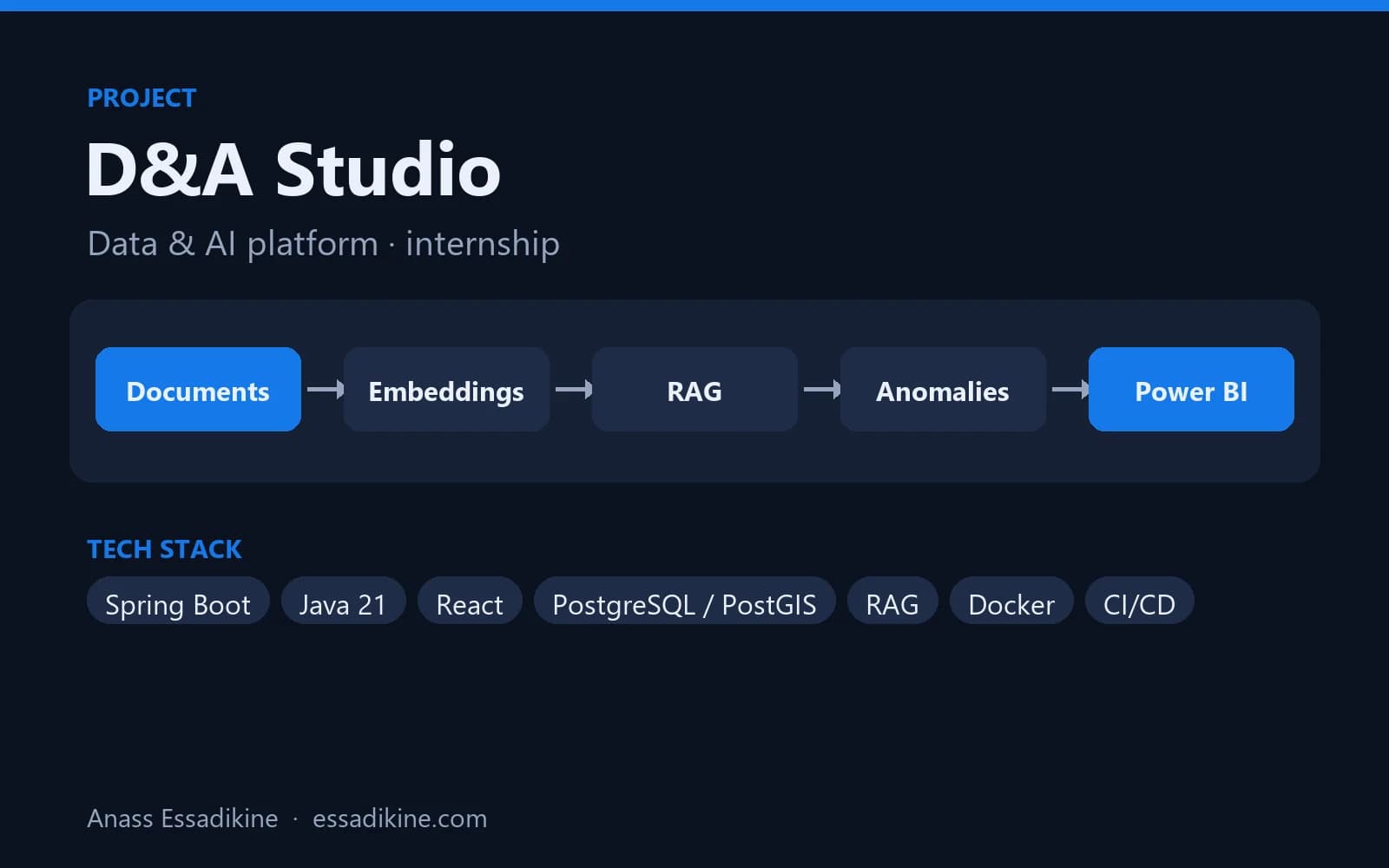
As an example of a project that covers several stages, the D&A Studio platform combines a Spring Boot (Java 21) back end, a React front end with maps, PostgreSQL/PostGIS, role-based access, a RAG assistant, Docker and CI/CD.
Portfolio checklist
| Item | Why it matters |
|---|---|
| Live demo URL | Recruiters click before they read |
| README with setup steps and screenshots | Shows you can document |
| Clear commit history | Shows how you work |
| Tests and CI badge | Signals professional habits |
| Short write-up of trade-offs | Gives interviewers something to discuss |
What does the full-stack job market look like in Morocco?
Without precise figures, a few patterns are widely observed in Morocco:
- IT service companies and offshoring centres, notably in Casablanca and Rabat, recruit developers for French-speaking and European clients. Java/Spring, Angular or React, and .NET appear often in their job posts.
- Banks, insurance, telecoms and large public or semi-public organisations run large internal systems, often in Java.
- Startups and digital agencies tend to use JavaScript/TypeScript stacks (React, Next.js, Node.js).
- Remote work and freelancing for foreign clients are real options; French is a strong asset for clients in France and Belgium. See the guide on finding your first freelance clients from Morocco.
Salaries vary widely by company, city, stack and experience, so check current job posts on LinkedIn and Moroccan job boards rather than relying on averages quoted without a source. A good habit: read twenty job posts for the role you want and list the skills that come up most often. That list is your personal roadmap.
Common mistakes to avoid
- Switching frameworks every month instead of finishing projects.
- Skipping SQL because an ORM "handles it".
- Never deploying anything.
- Copying AI-generated code without understanding or testing it.
- A GitHub full of forks and empty repositories.
How do you learn efficiently while working or studying?
Consistency beats intensity. One focused hour every day does more than a whole weekend once a month, because you keep the context in your head.
- Build in public: push to GitHub every session, even small changes.
- Read official documentation first, then tutorials. Docs age better and teach you to find answers on your own.
- Read other people's code: open-source projects and code reviews show patterns that courses skip.
- Write short notes on what you learned and what broke. They become blog posts, interview answers and portfolio write-ups.
Conclusion
The full-stack roadmap for 2026 is less about the number of tools and more about delivering complete features: data, API, interface and deployment. Choose one stack, build and deploy real projects, and add AI-assisted development as a multiplier, not a replacement for fundamentals. To see how these skills come together in practice, have a look at the full-stack developer profile.

Related projects
 AI & AutomationInternship · 2026
D&A Studio — Data & AI Platform (PaaS)
A platform that brings geospatial tracking data, an AI assistant on company documents, anomaly detection and BI dashboards into one place.
 Cloud & DevOpsAcademic project · 2024
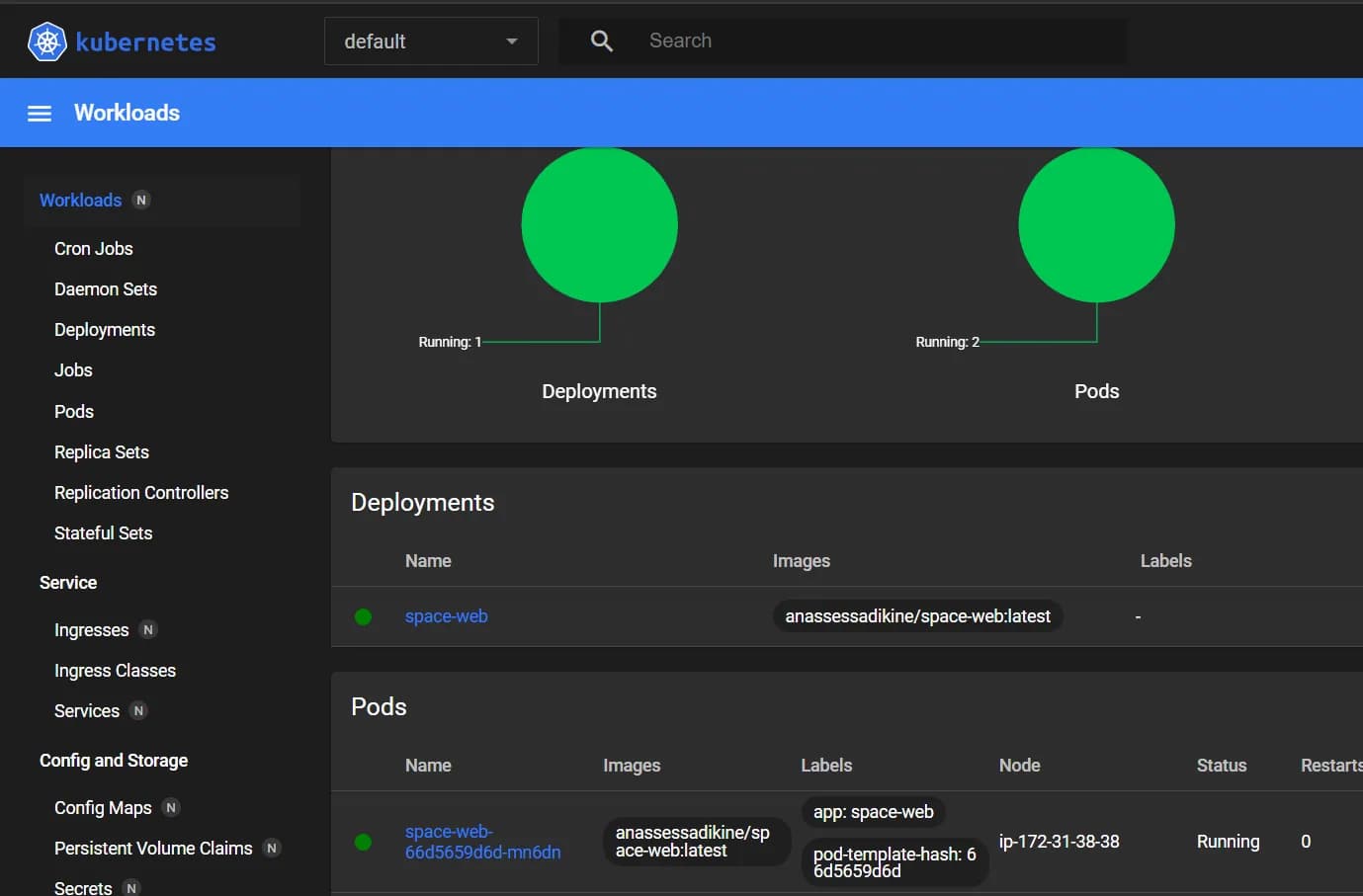
Cloud Deployment with Automated CI/CD
An end-to-end pipeline that builds, containerises and deploys a React app to Kubernetes on AWS on every push.
Frequently asked questions
Start with HTML, CSS, JavaScript and Git, then one front-end framework such as React. Move to the back-end only once you can build and deploy a small front-end app on your own.