Hiring a Data Engineer or a Data Freelancer in Morocco: The Guide
For recruiters, HR teams, agencies and companies: what to test, how to tell junior from senior, and how freelance data missions are scoped and priced.
Who this guide is for
This guide is for recruiters, HR teams, agencies and companies who want to hire a data engineer in Morocco, or a data freelancer for a defined project. It covers the choice between a permanent contract and a freelancer, the skills to test, interview questions with what a good answer looks like, a short take-home exercise, the signals that separate junior from senior profiles, and how freelance missions are scoped and priced.
If you need a refresher on the role itself, start with what a data engineer does in Morocco.
Permanent contract (CDI) or freelancer?
Both are valid. The right choice depends on how long the need lasts and how much of it is already defined.
| Question | Permanent hire (CDI) | Freelancer |
|---|---|---|
| Nature of the need | Ongoing: a data platform to build and run for years | Scoped: a pipeline, a warehouse, a dashboard, an audit |
| Time to start | Often several weeks to months (search, notice period) | Often a few days to a few weeks |
| Knowledge retention | Stays in the company | Must be secured with documentation and handover |
| Cost structure | Salary, contributions, equipment, management time | A quote per mission or per period, invoiced |
| Best when | Data is central to the business and changes every week | You need a result fast, or want to test a use case first |
A common path is to start with a freelancer on a first, well-defined project (for example a first automated pipeline and one dashboard), then hire internally once the platform and its workload are clear. The freelancer's documentation then becomes the onboarding material of the new hire.
Which skills should you test?
A data engineer CV usually lists many tools. Test the skills behind them on realistic cases.
| Skill | What to check | How to test it |
|---|---|---|
| SQL | Joins, aggregations, window functions, deduplication, performance | Live exercise on a small schema |
| Python | Reading files and APIs, error handling, clean functions, tests | Take-home or pair-programming |
| Data modelling | Star schema, grain, fact vs dimension, slowly changing dimensions | Whiteboard discussion on your own business |
| ETL / ELT | Incremental loads, idempotent re-runs, scheduling, data quality checks | Design question |
| Cloud | One provider in depth, storage, compute, access rights, cost | Questions on a project they actually deployed |
| Power BI (if reporting is in scope) | Data model, DAX measures, refresh, row-level security | Review of a report they built |
Interview questions and what a good answer contains
SQL. "A table of orders contains duplicates for the same order_id, loaded twice. Keep only the most recent row per order." A good candidate uses a window function and explains why:
SELECT *
FROM (
    SELECT o.*,
           ROW_NUMBER() OVER (PARTITION BY order_id ORDER BY loaded_at DESC) AS rn
    FROM staging.orders AS o
) AS t
WHERE rn = 1;
Follow up with: "How would you prevent the duplicates instead of cleaning them?" You expect a unique key and an idempotent load (upsert), not only a cleaning query.
Python. "An API returns 50,000 records in pages of 500 and sometimes times out. How do you load it reliably?" Look for pagination, retries with a delay, logging, and writing raw data before transforming it.
Modelling. "We want daily sales by store, product and salesperson. Draw the model." A good answer states the grain first (one row per sale line, or per day and store), then the fact table and its dimensions. Seniors raise history questions spontaneously: what happens when a salesperson changes store?
ETL and operations. "A daily job failed at night and the dashboard shows yesterday's figures. What do you do?" You want a calm sequence: check logs, find the cause, fix, re-run safely without duplicates, tell the users, add a check or alert so it does not happen silently again.
Cloud and cost. "Which cloud resources did your last pipeline use, and roughly what did it cost per month?" Candidates who really deployed something answer concretely; others describe a tutorial.
Power BI. "Why should a measure be preferred to a calculated column for a total?" A good answer mentions evaluation in filter context, model size and refresh time.
A small take-home exercise (2 to 3 hours)
Keep it short: a long unpaid exercise discourages the best candidates.
- Provide two CSV files (for example orders and customers) with a few realistic problems: duplicates, missing values, inconsistent dates.
- Ask for a script in Python or SQL that loads them into a local database (SQLite or PostgreSQL in Docker), cleans them and builds one fact table and one or two dimensions.
- Ask for three data quality checks that fail loudly, and a README of one page: choices, assumptions, what they would do with more time.
Score it on a grid agreed in advance: correctness of the result, re-run safety, readability, tests or checks, and the quality of the README. The README often tells you more about seniority than the code.
Junior vs senior: the signals
| Signal | Junior | Senior |
|---|---|---|
| Talks about | Tools and courses | Trade-offs, failures and their causes |
| SQL | Correct queries | Correct, fast queries and an explanation of the plan |
| Pipelines | A pipeline that runs once | Re-runs, incremental loads, monitoring, alerts |
| Modelling | Knows what a star schema is | Chooses the grain and defends it with the business need |
| Production | Little or none | Has been responsible for jobs others depend on |
| Communication | Answers the question | Asks about the business before proposing a solution |
A strong junior is not a weak senior: look for curiosity, clean code, honest README files and at least one end-to-end project, even academic. For example, an academic or internship project that loads heterogeneous files into a star-schema warehouse, like the CNSS decision-support project, already shows modelling and ETL thinking.
Red flags
- A long list of tools with no project where they were used together.
- No question about your data, your users or your constraints before proposing a stack.
- Cannot explain what happens when a job runs twice.
- Every problem is solved with a new tool rather than with SQL, a check or a simpler design.
- For freelancers: no written scope, no deliverables list, or a refusal to document and hand over access.
- Promises of "real time" or "AI" before the basic data quality is known.
How freelance data missions are scoped and priced
Freelance data missions in Morocco are usually priced in one of two ways.
- Fixed price per deliverable: the scope is written (sources, tables, pages, refresh), the price is fixed, and changes go through a small amendment. It suits well-defined needs and gives the client a known budget.
- Time-based: the client pays for time spent, per day or per hour, on a backlog that can change. It suits ongoing support, exploration and platforms whose scope is not yet clear.
In both cases, a short audit or discovery call comes first: the number of sources, the volume, the data quality and the refresh frequency drive the effort far more than the tool.
Real starting prices as examples
As a concrete reference, here are the "from" prices of the five services I offer as a freelancer. They are starting points for the smallest scope, not day rates, and the final price is set after a short exchange on your data.
| Service | Starting price | Smallest scope |
|---|---|---|
| Data engineering and ETL pipelines | from 2,500 MAD | A first automated pipeline |
| Power BI and Looker Studio dashboards | from 1,500 MAD | A one-page dashboard on one source |
| AI automation and RAG assistants | from 1,000 MAD | A simple automation; RAG assistants on quote |
| Next.js website development | from 3,000 MAD | A landing page; applications on quote |
| Technical SEO | from 800 MAD | An audit; fixes on quote |
A multi-source warehouse with several dashboards is quoted on its own scope; the table only shows where the smallest useful deliverable starts.
A brief template you can copy
Sending this brief before the first call saves a meeting and makes quotes comparable between candidates or freelancers.
1. Context: company, team, who will use the data.
2. Goal: the decision or process to improve, in one sentence.
3. Sources: systems and files (ERP, CRM, Excel, APIs), approximate volume.
4. Expected deliverables: pipeline, warehouse tables, dashboard pages, documentation.
5. Refresh: daily, hourly, on demand.
6. Constraints: hosting, cloud already used, security and personal data rules.
7. Access: who provides credentials and sample data, and when.
8. Timeline and budget range.
9. Contract type: permanent role, fixed-price mission or time-based support.
10. Success criteria: how you will know the project worked.
Conclusion
Hiring a data engineer or a data freelancer in Morocco works best when the need is written down first. Choose a permanent role for ongoing platform work and a freelancer for a scoped deliverable, test SQL, Python, modelling and operations on realistic cases, and judge seniority on trade-offs and production experience rather than on the length of the tool list.
If you are a recruiter, the recruiters page gathers my profile, CV and availability. If you have a project, describe it through the contact page.
- Hiring
- Data engineer
- Freelance
- Morocco
- Interview
- SQL
- Power BI
Share this article

About the author
Anass Essadikine
Data & AI Engineer and Software Engineer based in Casablanca, Morocco. I build data platforms, Power BI dashboards, RAG assistants and Next.js / Spring Boot applications.
Related projects
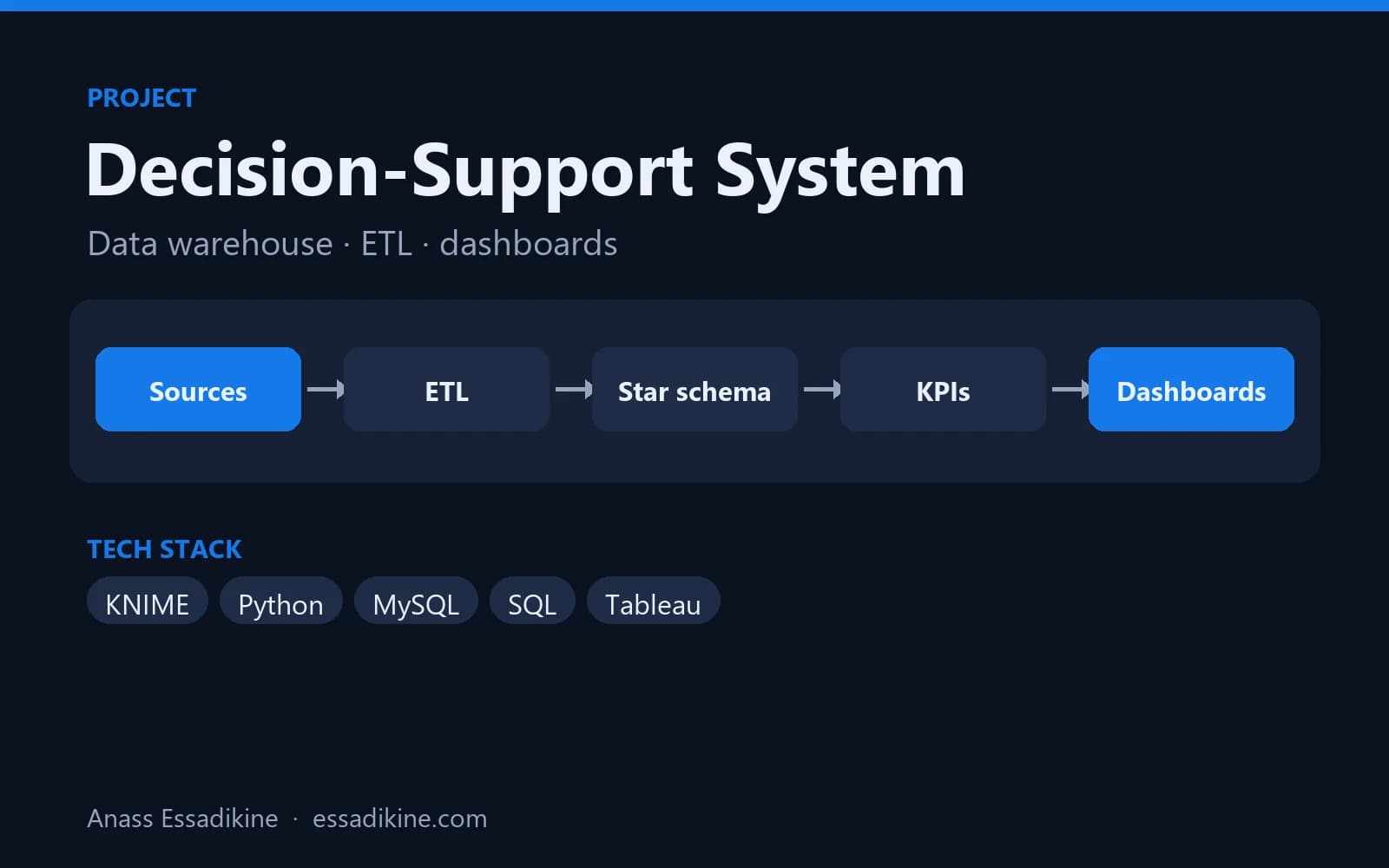
Decision-Support System for Social Security Data (CNSS)
A star-schema data warehouse fed by ETL flows, with analytics dashboards for decision-makers.
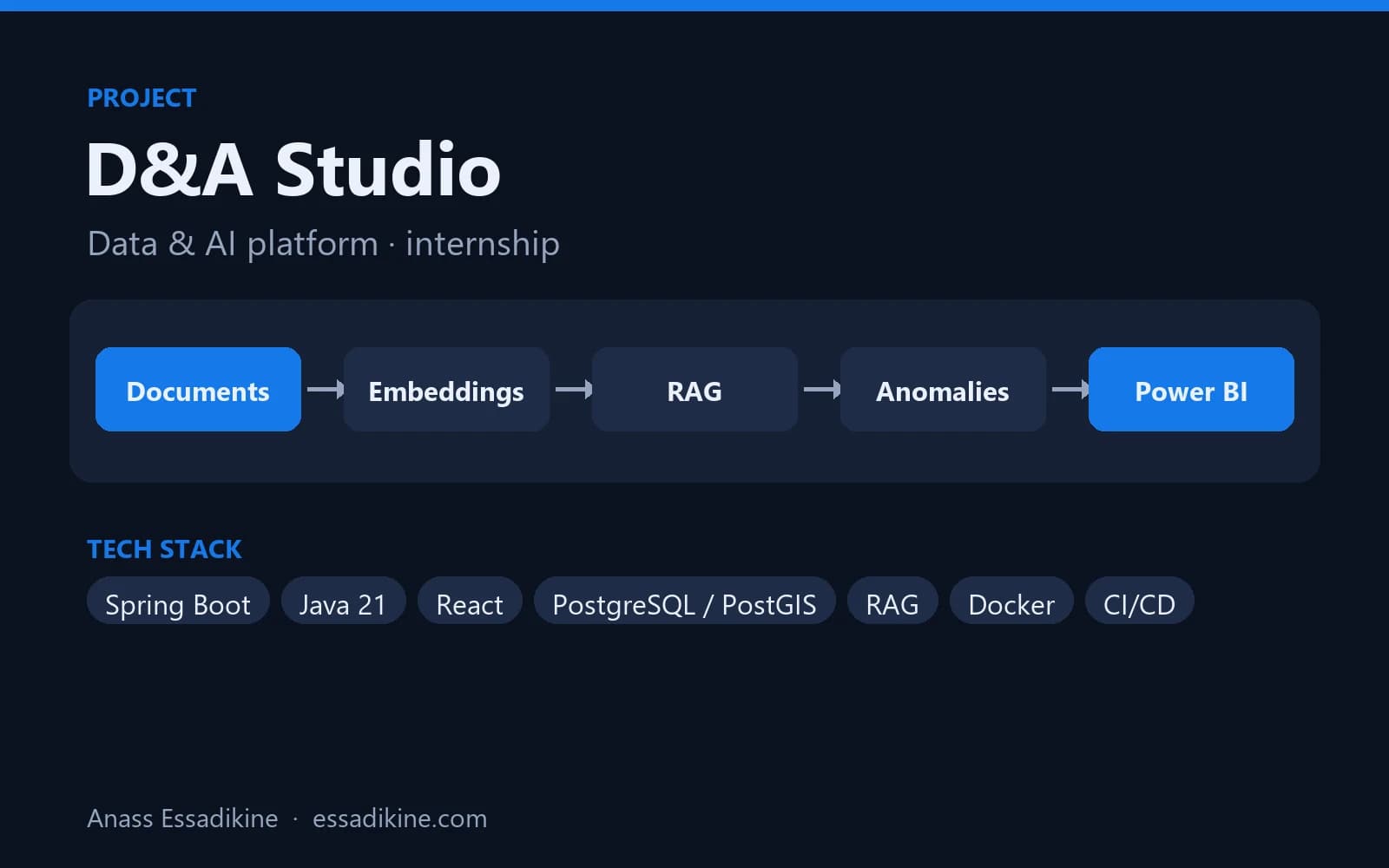
D&A Studio: Data & AI Platform (PaaS)
A platform that brings geospatial tracking data, an AI assistant on company documents, anomaly detection and BI dashboards into one place.
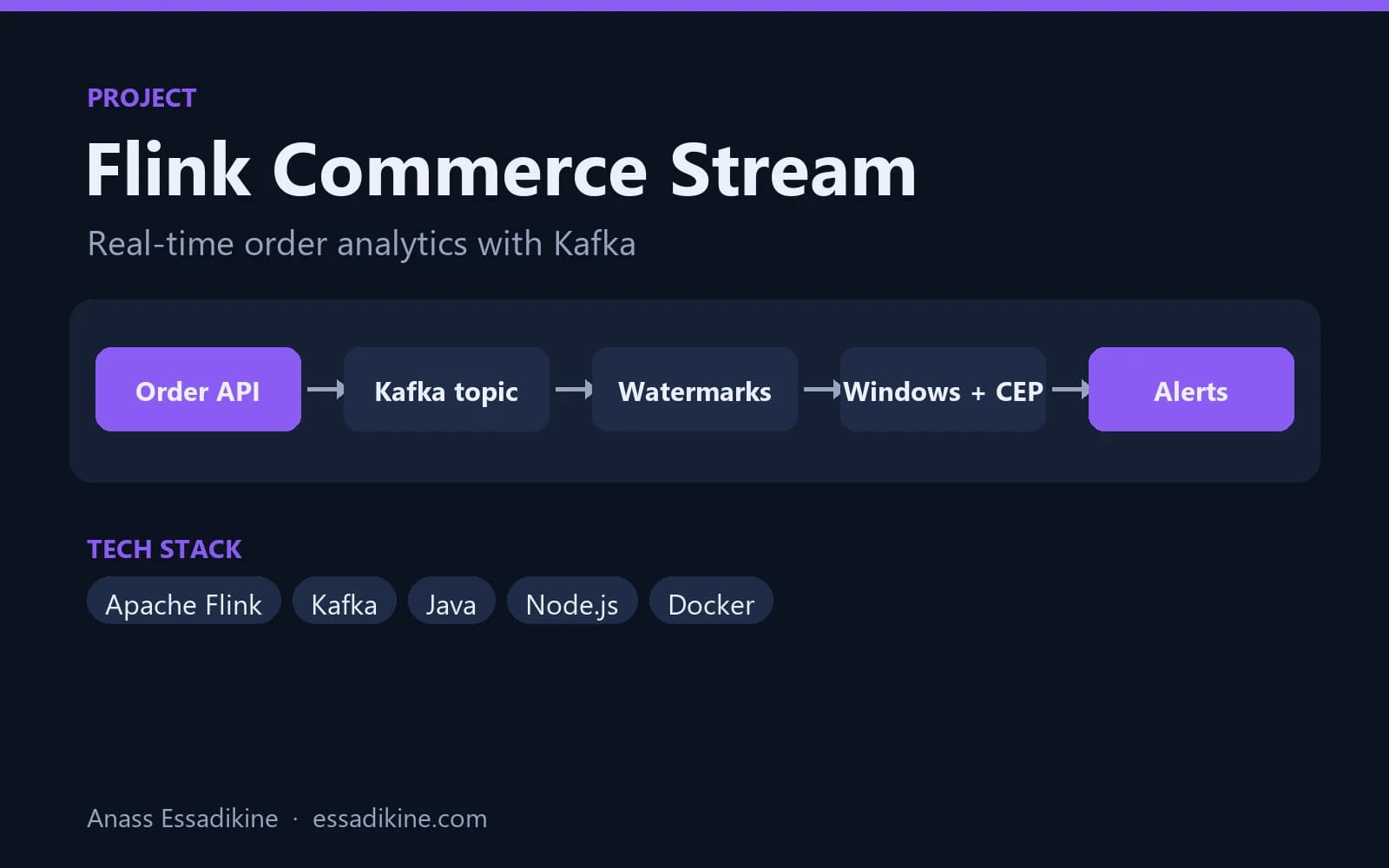
Real-Time E-commerce Streaming with Flink and Kafka
A stream-processing lab where orders created through a Node.js API flow into Kafka and are analysed live by an Apache Flink job with event-time windows, enrichment and fraud-style pattern detection.
Frequently asked questions
Hire permanently when data is central and the platform needs continuous work. Choose a freelancer for a scoped deliverable such as a first pipeline, a warehouse or a dashboard, or to test a use case before building a team. Many companies start with a freelancer and hire once the workload is clear.
A live SQL exercise with window functions and deduplication, a Python question on reliable API loading, a modelling discussion on your own business, an operations scenario about a failed nightly job, and questions about a cloud project the candidate really deployed.
Two to three hours is enough to judge code quality, re-run safety and documentation. Longer unpaid exercises discourage experienced candidates. Score it with a grid agreed in advance and read the README carefully.
Either at a fixed price per deliverable, when the scope is written and stable, or on time spent, for ongoing support and evolving scopes. A short audit of sources, volume, quality and refresh frequency usually comes first, because those factors drive the effort.
As one real example, my services start at 2,500 MAD for a first automated pipeline and 1,500 MAD for a one-page Power BI dashboard on one source. Larger, multi-source projects are quoted after a short exchange on the data.